In one line
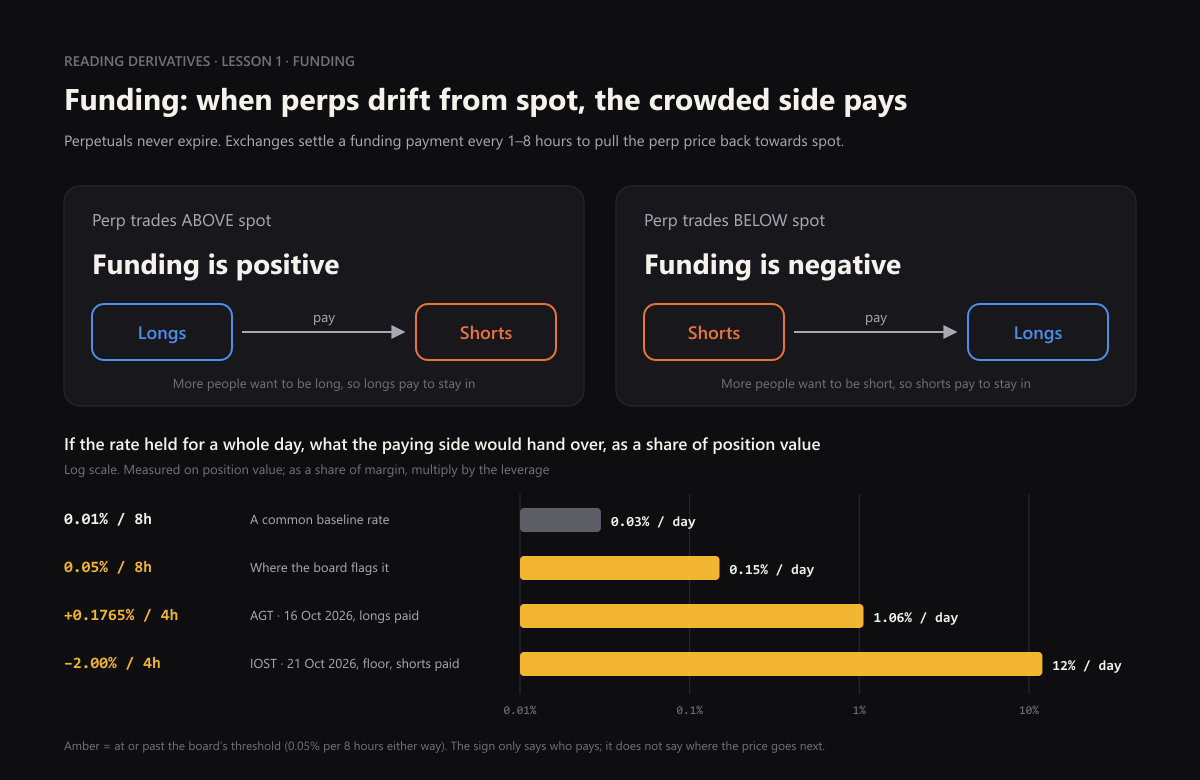
Perpetual futures never expire. To stop the perp price wandering away from spot, the exchange makes longs and shorts settle a funding payment every few hours:
- when the perp trades above spot, funding is positive and longs pay shorts;
- when the perp trades below spot, funding is negative and shorts pay longs.
The money moves between traders; the exchange does not keep it. If people are willing to pay just to keep a position open, that side has more people, and they want in more badly. That is why funding is the most direct gauge of which side is crowded.
How it is calculated and how often
- Settlement interval: most large tokens on Binance settle every 8 hours, many small tokens every 4 hours, and some get shorter intervals. Rates on different intervals cannot be compared directly; convert them to the same period first. The board converts everything to per 8 hours.
- The premium drives it: how far the perp trades above or below the spot index. There is also a small interest component, 0.01% per 8 hours on Binance, which is why in a calm market funding often sits at exactly +0.01%.
- It is capped: funding cannot grow without limit. The −2.00% (per 4 hours) that IOST hit on 21 October, in issue 005, was the floor at the time.
- Only positions open at the moment of settlement pay or receive, and the amount is a share of position value, not of margin.
Turning the rate into a daily cost shows how heavy it is:
| Rate | Settlements a day | Share of position value per day |
|---|---|---|
| 0.01% / 8h (common baseline) | 3 | 0.03% |
| 0.05% / 8h (board threshold) | 3 | 0.15% |
| 0.1765% / 4h (AGT, 16 Oct) | 6 | about 1.06% |
| 2.00% / 4h (IOST, 21 Oct) | 6 | 12% |
This assumes the rate held for a whole day; in practice it changes at every settlement. As a share of margin, multiply by the leverage.
How to read it
- Sign first: positive means the long side is crowded, negative means the short side is. The sign only says who is paying, not where the price goes next.
- Then size: hugging +0.01% is normal. At 0.05% per 8 hours either way the board flags it; above 0.1%, the paying side’s daily cost is already substantial.
- Read it with price: deeply negative funding while the price rises means shorts are paying and being pushed by the price at the same time, the classic set-up for a short squeeze. Deeply positive funding while the price stalls means longs are paying and still cannot move it.
- Read it with open interest: extreme funding with OI still rising means the crowding is getting worse; funding back to normal with OI falling often means the episode is over (see lesson 2).
Real case: IOST funding hits the floor
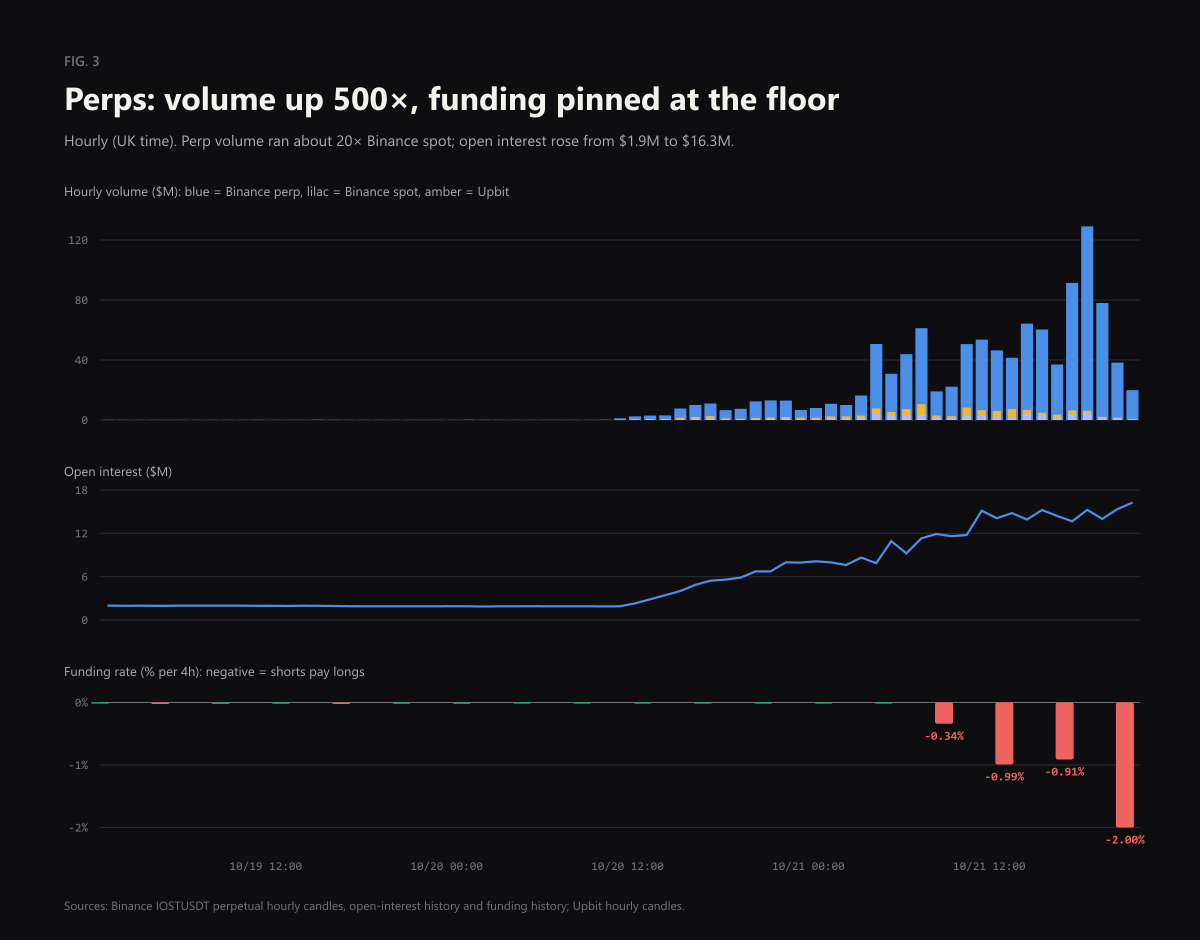
Issue 005, IOST, is a textbook negative-funding move:
- until 05:00 on 21 October, IOST funding was +0.005% every 4 hours, perfectly calm;
- the next settlements were −0.34%, −0.99% and −0.91%, and at 21:00 it hit the −2.00% floor;
- in the 18:00 hour that day, the perp traded 24.5% below spot.
Funding that negative and a perp that cheap mean a lot of people were short on the perp, and with spot hard to borrow, shorts had nowhere else to go. As spot kept rising, shorts paid a large funding bill every 4 hours while being forced to close, and closing a short means buying the perp back, which pushed the price higher still. That day, as funding went ever more negative, the price kept climbing.
Compare two other issues:
- AGT settled at +0.1765% (per 4 hours) at 05:00 on 16 October: the other direction, with longs paying heavily to stay in;
- ICNT had negative funding for most of its rally, but mildly (−0.039% at 09:00 on 17 October): some shorts leaning against it, nowhere near IOST.
Common mistakes
- “Negative funding means it will fall.” No. It only means more people are short and shorts are paying. In the IOST case, funding was at its most negative while the price rose.
- “Funding is how whales harvest traders.” Funding follows a formula and moves between longs and shorts; neither the exchange nor the project keeps it. The receivers are whoever sits opposite the crowd.
- “Calm funding means safe.” Calm funding only means the perp is close to spot. SIREN’s October funding stayed mostly within ±0.1%, and the price still doubled and fell back to where it started.
Now look at the board
On the derivatives board, the crowding map’s horizontal axis is funding, converted to per 8 hours: further left, shorts are paying more; further right, longs are. Tokens past ±0.05% turn amber. Open a token’s row to see its settlement interval.
In short: funding tells you which side is spending money to stay in the game. It is a thermometer for crowding, not a compass for direction.
This article only explains what the measure means and how to read it. It is not investment advice and makes no buy, sell, leverage or position-size suggestions.
The board refreshes every 15 minutes and the wallet tracker every hour. Both describe the market only and never suggest a trade.