
- Eight of the top ten addresses received their tokens directly from the deployer or its distribution wallet; four of them were funded with gas by the same wallet in the same minute
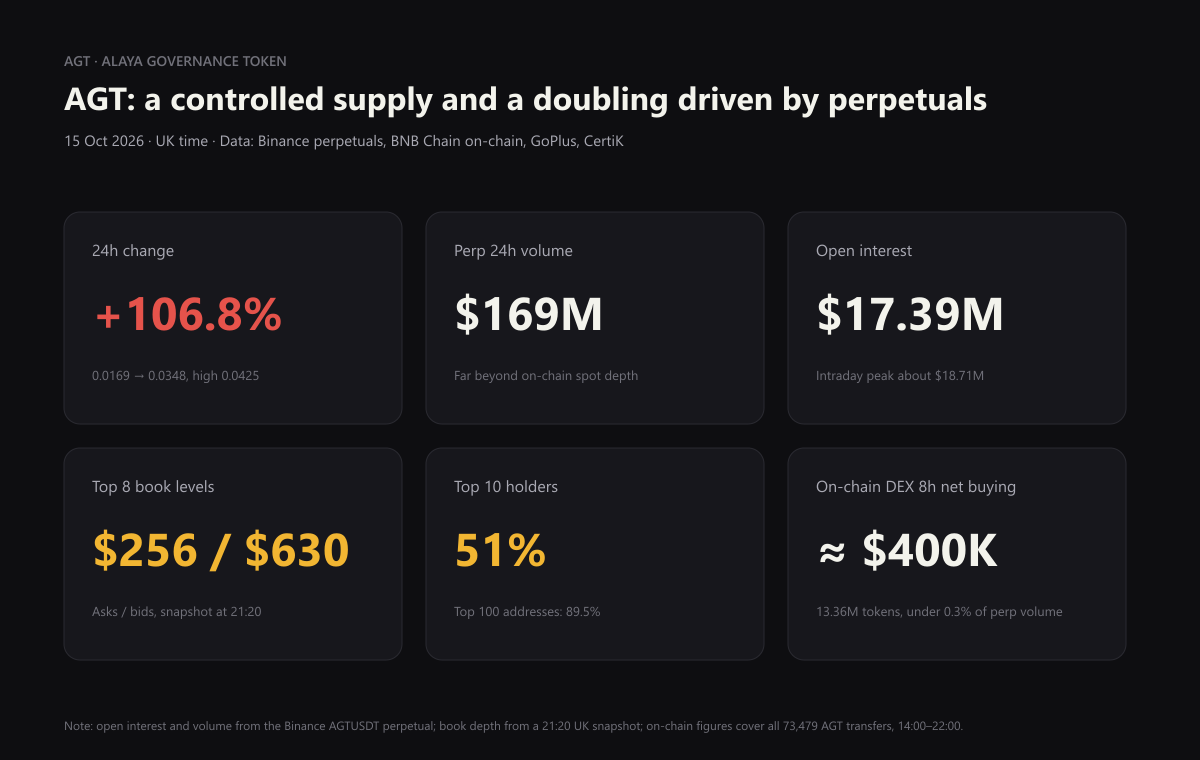
- The price doubled in two hours; 24h perpetual volume of $169M was about 420 times net on-chain buying
- $17.39M of open interest sat on an order book with only $256 across the top eight ask levels
- Project-linked addresses did not move a single token during the pump; about 556 million released tokens remain untouched
Subject: contract
0x5dBde81fcE337FF4bcaaEe4Ca3466C00aeCaE274on BNB Chain (Alaya Governance Token), and the Binance AGTUSDT perpetual. Times are UK time. On-chain data comes from BNB Chain transfer records; derivatives data from Binance’s public API.
The short version
1. The supply is controlled by one entity, and the chain proves it. Eight of the ten largest addresses received their AGT directly from the deployer or its distribution wallet, about 46% of supply in total. Four of them were funded with gas by the same operations wallet, 0.01 BNB each, within the same minute. They are all ordinary wallets with no vesting contract attached, so the tokens can move at any time.
2. The doubling happened on perpetuals, not spot. From 16:00 UK time, the price went from 0.0152 to 0.0325 in two hours, with $169 million of perpetual volume over 24 hours. Over eight hours, net on-chain DEX buying was only about $400,000, less than 0.3% of perpetual volume. $17.39 million of open interest sat on an order book with just $256 across the top eight ask levels.
3. Project-linked addresses did not sell a single token during the pump. The top ten addresses, the operations wallet and the deployer moved no AGT between 14:00 and 22:00. The 391 million tokens released from these addresses in July–September, plus 165 million sent out by the distribution wallet in August and September (about 556 million in total), also remain untouched.
4. Who pushed the price on perpetuals is not visible on-chain. Derivatives accounts live inside the exchange, and only the exchange knows them. The evidence proves “a controlled structure”; it does not prove “someone manipulated the perpetual market”, and this report draws no conclusion on the latter.
What AGT is
AGT is the utility and governance token of the Alaya AI ecosystem. The project uses gamified tasks to get users to collect, label and verify data, then supplies that data to AI projects. Features include data crowdsourcing, custom data requests, auto-labelling, NFT identities and model staking pools (official docs).
According to the official AGT page, AGT is used for governance, NFT upgrades, custom data requests and access to advanced tasks; staking alone does not earn passive income. AGT is not equity, and holding it gives no claim on platform revenue.
AGT is not the same as ATP, a testnet token in the PlatON ecosystem; the names are merely similar.
Product: it exists, but the business is unproven
The platform and its task system do exist. But judging whether a business works means answering five questions: who pays, how much, for what, whether they come back, and how the token shares in the revenue. Alaya’s public materials answer none of them convincingly.
- In 2023 the project claimed 400,000 registered users and 15,000 daily active users, but registering, checking in and claiming rewards are not the same as delivering training data to companies.
- The project says platform revenue will be used to buy back AGT, but has never published revenue, buyback rules, the executing address or any purchase records.
- Model tokenisation, auto-labelling and privacy protection lack reproducible benchmarks and public code.
AGT’s uses mostly circulate inside the ecosystem: earn tokens by doing tasks, spend tokens to upgrade NFTs, stake to unlock tasks. Without external companies paying continuously, this loop has no real money flowing in.
Team: no one we could verify
The docs, the website and exchange announcements do not clearly list founders or management. Names circulating online such as “Sarah Chen” and “Michael Rodriguez” come from unofficial pages and cannot be verified. CertiK shows the project has not passed CertiK KYC.
On funding, all we could confirm is that it was a candidate in BNB Chain MVB season 8 and listed spot on KuCoin. Claims such as “backed by Binance Labs” or “raised more than $15 million” appear only on exchange coin-profile pages, with no formal investment announcement behind them.
How the pump unfolded
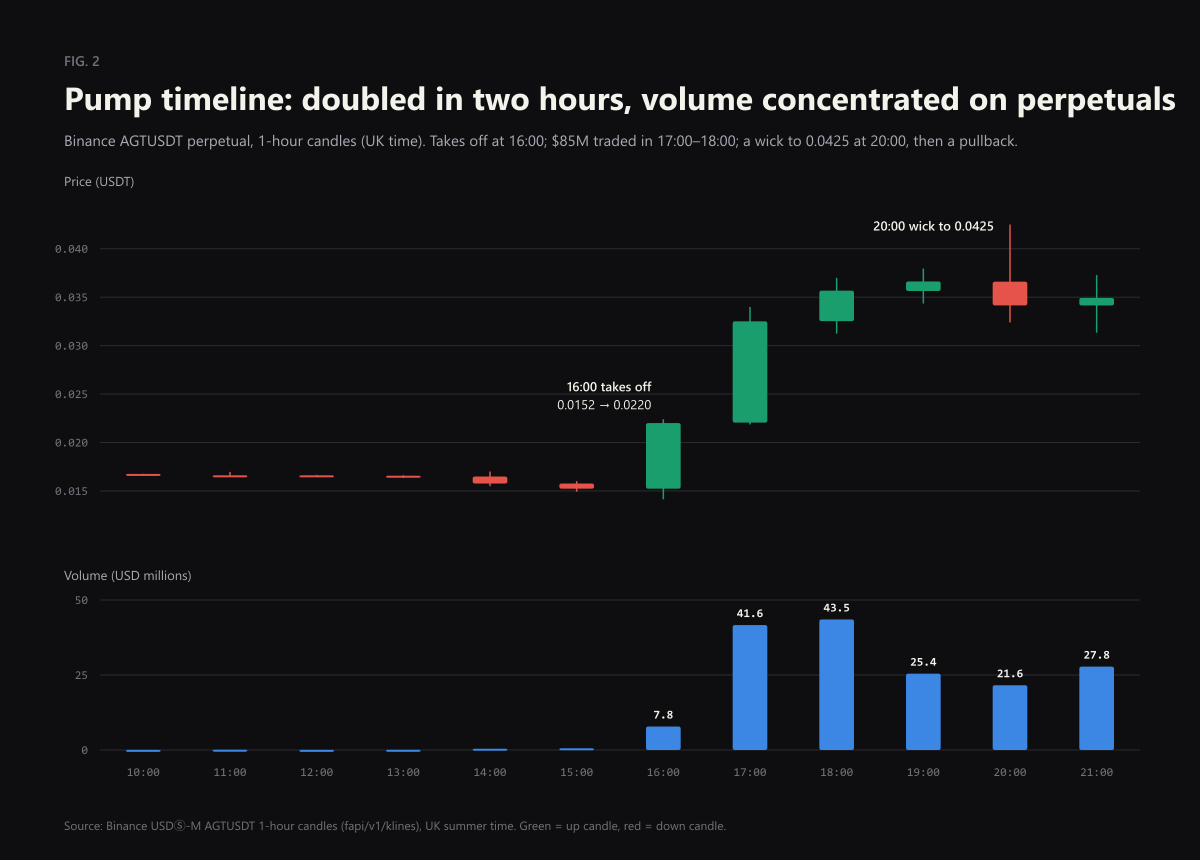
Before 16:00 the price sat around 0.0165 for most of the day, with only tens to hundreds of thousands of dollars of perpetual volume per hour. In the 16:00 hour it went from 0.0152 to 0.0220, then rose another 47% in the 17:00 hour; those two hours traded about $85 million. At 20:00 a wick hit 0.0425 before the price fell back to about 0.034.
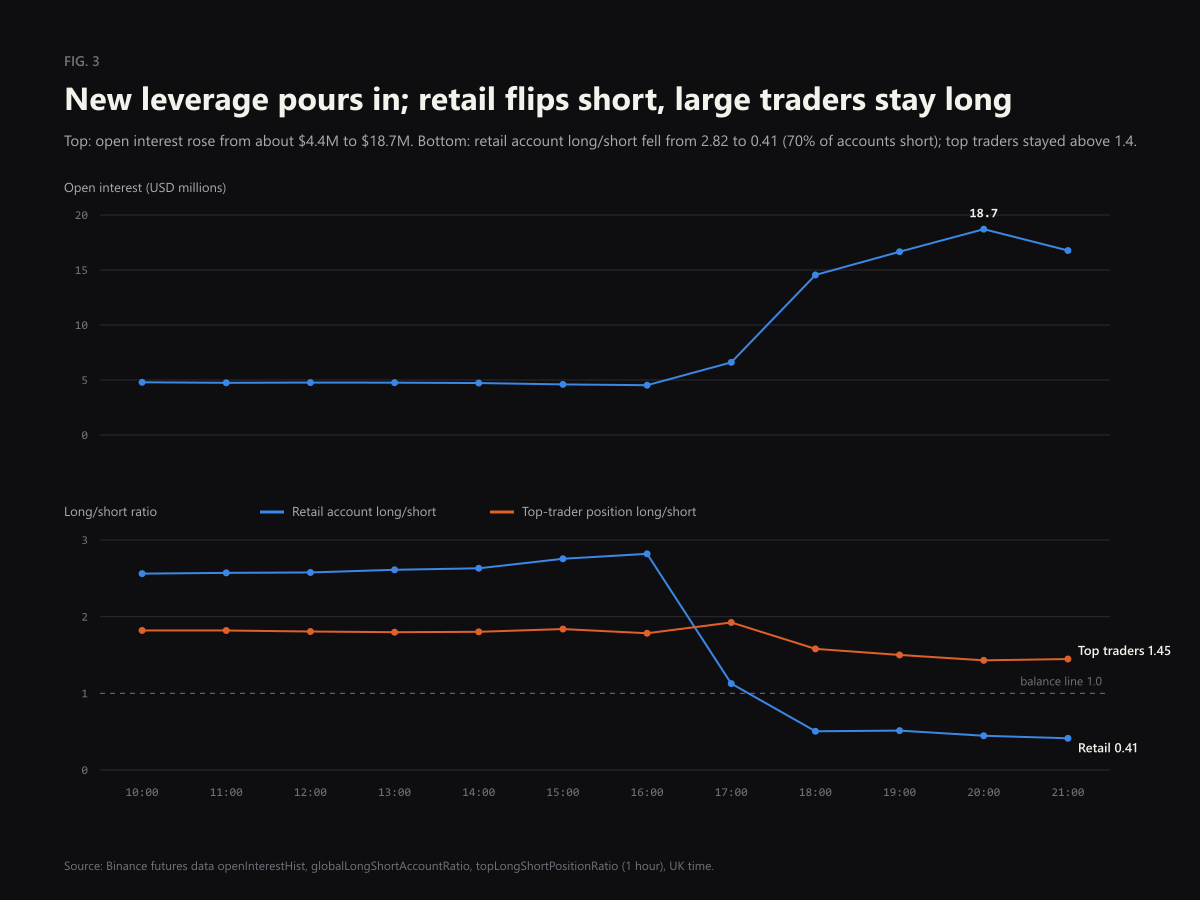
Open interest rose from about $4.4 million to $18.71 million, showing that the rally brought in a lot of new leverage. Over the same period the retail account long/short ratio fell from 2.82 to 0.41: 70% of accounts flipped to short on the way up, while the top-trader position ratio stayed above 1.4. Crowded retail shorts against long-leaning large traders is the classic structure for a short squeeze. Funding reached 0.0865% at 21:00 (settled every four hours), a sign of severe imbalance.
Holdings: controlled by one entity
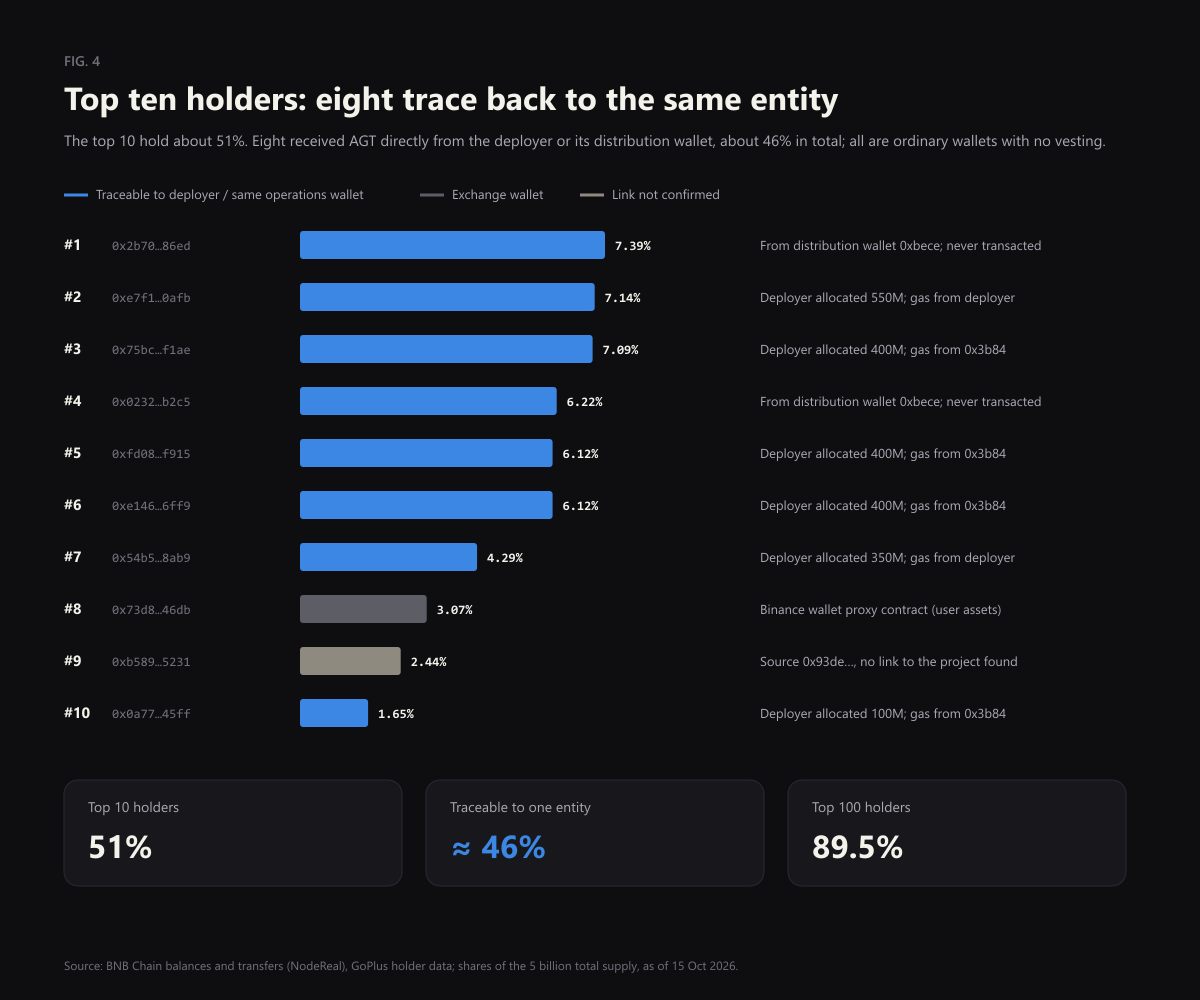
The top ten addresses hold about 51%, the top hundred about 89.5%. Tracing the transfer history of each:
- #2, #3, #5, #6, #7 and #10 received their AGT directly from the deployer within minutes of minting on 15 April 2025;
- #1 and #4 received theirs from the distribution wallet
0xbece45649e0bd6930c0bfa823d085c48e45e50b3; neither has ever sent a transaction; - #8 is a Binance wallet proxy contract (user assets); for #9 we found no link to the project. (Added 17 Oct 2026: #9’s 156 million tokens came on 16 April 2025 from
0x93deb693b170d56bdde1b0a5222b14c0f885d976, and about 33 million were later sent in two transfers to0x73d8bd54f7cf5fab43fe4ef40a62d390644946db.0x93de…d976is one of the largest holders of many Binance Alpha and airdrop tokens, and a news report says tokens pass through it before reaching Binance wallets; ICNT, in our second issue, also allocated 8.75 million tokens to it at launch. It is very likely an address used for exchange listings or airdrop distribution, but its owner cannot be confirmed on-chain, and we found no dealings between it and the AGT project.)
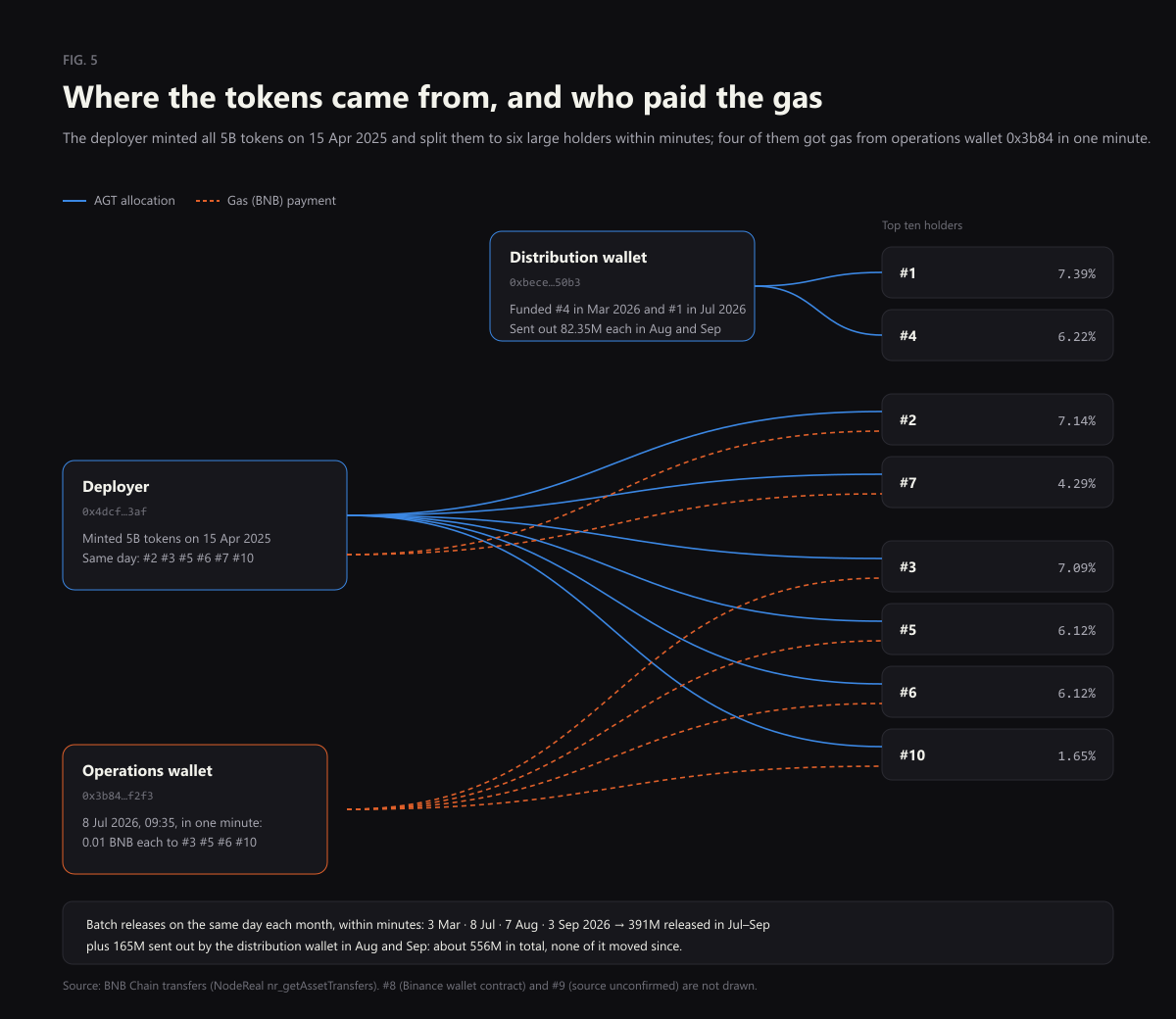
Where the gas came from further shows one entity is operating them: the deployer paid gas for #2 and #7; #3, #5, #6 and #10 each received 0.01 BNB from the operations wallet 0x3b84713bbadc3e7ecd35af454dac06a252f3f2f3 in the same minute, at 09:35 on 8 July 2026. In May 2025 this operations wallet also received 200 million released tokens and sent about 190 million into the main PancakeSwap pool.
These wallets release on a fixed rhythm: on 3 March, 8 July, 7 August and 3 September 2026, each released in turn within a few minutes on the same day, in amounts equal to its allocation divided by a fixed number of instalments (for example 400 million ÷ 35 = 11,428,571), each time to a brand-new address. The 391 million released in July–September, plus 165 million sent out by the distribution wallet in August and September, have not moved since.
Once in the past, project-linked tokens did reach an exchange: 55.55 million released by #2 on 3 March 2026 passed through an intermediary and were deposited on 12 May 2026 to a centralised-exchange hot wallet (with more than 4.6 million transactions).
The action is on perpetuals
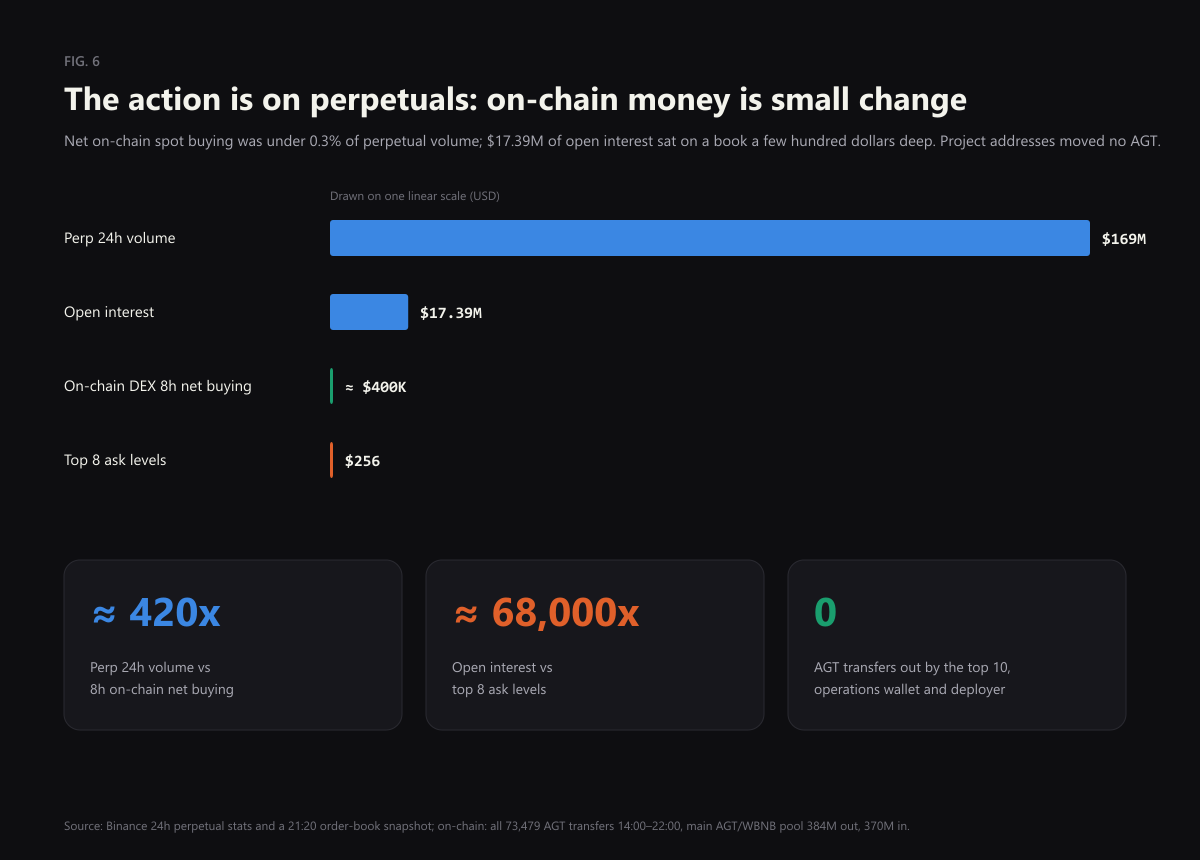
Between 14:00 and 22:00 there were 73,479 AGT transfers on-chain, none larger than 3 million tokens. The main AGT/WBNB pool saw 384 million tokens out (buys) and 370 million in (sells): net buying of about 13.36 million tokens over eight hours, roughly $400,000 at the average price.
Compare the perpetual: 24h volume of $169 million, about 420 times net on-chain buying; open interest of $17.39 million, about 68,000 times the depth of the top eight ask levels. On a book like this, an order of a few thousand dollars can clear several levels, and very little money can wick the price in both directions.
This move was not driven by large spot holders selling: the project addresses did not move and on-chain money was small. It happened in a thin, highly leveraged perpetual market. Who opened how much on perpetuals, only Binance knows.
Update: price doubled again early on 17 October
Updated 17 Oct 2026, 11:45 UK time
Bottom line: the third pump was the largest and again happened on perpetuals. The controlling addresses did not move; one of the long wallets on Aster started taking profit near the top.
Doubled in two hours, half given back in two minutes
| Time | Binance AGTUSDT perpetual |
|---|---|
| 00:16 | 0.0515 → 0.0661 in one minute, $14.62M traded that minute |
| 01:35–01:53 | Up to 0.1048, 111% above 0.0497 at 00:00; $13.86M traded in the 01:53 minute |
| 02:27–02:28 | Down to 0.0542 in two minutes |
| 05:12 | Back up to 0.093 |
| 08:31 | Back to 0.059 |
| 11:43 | About 0.072, up about 82% in 24 hours |
24h perpetual volume was about $885 million. Open interest rose from $31 million at 20:00 the previous evening to $49.3 million at 05:00, then fell back to $36.9 million at 11:00. Funding at the 05:00 settlement was 0.1765% (every four hours), a high cost for longs paying shorts. The retail account long/short ratio rose from 0.33 to about 0.51 and the top-trader position ratio from 1.17 to about 1.40: clearly more traders went long this time.
On-chain: spot money still small
- From 23:30 on 16 October to 11:45 on the 17th there were 173,561 AGT transfers. The main pool saw 691 million tokens sold and 697 million bought, net buying of only about 5.85 million tokens (about $400,000), roughly 1/2000 of perpetual volume over the same period.
- Only one batch of 4 million tokens exceeded 3 million in a single transfer: from a contract wallet that had withdrawn from exchanges several times since 2025, through an intermediary, into a busy contract holding about 175 million tokens (suspected trading-platform custody). This trail has no dealings with the controlling cluster.
- The 43 addresses in the controlling cluster (deployer, top ten, operations wallet, distribution wallet and every release recipient): still not a single AGT transfer out.
The long wallets on Aster start taking profit
Of the five wallets, E cut its position by about 6.04 million tokens between 23:17 on 16 October and 00:17 on the 17th, realising about 311,000 USDT; by 10:07 it had cut about 150,000 more, for about 322,000 USDT realised in total, with 1.87 million tokens remaining. E had the lowest average entry of the five, 0.0141. A, B, C and D did not move; together the five wallets still hold about 47.98 million tokens long.
E trades through the API, and the Aster explorer only records deposits, withdrawals and transfers, not fills, so the exact minute within that hour cannot be determined.
Update: a second spike on the evening of 16 October
Updated 16 Oct 2026, 21:05 UK time
Bottom line: like 15 October, this spike happened on perpetuals; on-chain spot money was small and the controlling addresses did not move a token.
Up 21% in one minute, then a pullback
| Time | Binance AGTUSDT perpetual |
|---|---|
| 20:34 | 0.0440 → 0.0532 in one minute (+21%), $13.67M traded that minute, 66% taker buys |
| 20:35 | Back to 0.046 |
| 20:58 | Back to 0.0434 |
| 21:05 | About 0.0425, up about 14% in 24 hours, about $410M of 24h volume |
The 20:00 hour traded $50.7 million on perpetuals, against $8–28 million an hour before that. Open interest grew steadily through the day: about $24 million at 09:00 and about $31 million at 20:00.
Before the spike, the Binance retail account long/short ratio was about 0.33, meaning most accounts were short; the top-trader position ratio was about 1.18. A one-minute spike and pullback while most accounts are short looks like a cluster of forced short liquidations, but Binance does not publish individual liquidations, so this cannot be verified.
On-chain: spot barely took part
- 10,143 AGT transfers between 19:30 and 21:00; the main AGT/WBNB pool saw 47.43 million sold and 48.24 million bought, net buying of only about 800,000 tokens (about $35,000).
- No single transfer of 3 million tokens or more.
- The 43 addresses in the controlling cluster: no AGT transfers out since 15 October.
The five long wallets on Aster
Positions unchanged: still 54,175,561 tokens long at 2x in total. At the 20:58 price, combined unrealised profit was about $1.43 million (about $1.16 million at 12:44). The wallets did not use the spike to close.
Update: five long wallets on Aster
Updated 16 Oct 2026
On 16 October, on-chain monitoring account Lookonchain reported that five wallets on the decentralised perpetual exchange Aster were long a combined 50.17 million AGT at 2x leverage, with about $887,000 of unrealised profit (as relayed by PANews). We obtained the five addresses and traced their funding on BNB Chain one by one.
Bottom line: the five wallets are controlled by one operator, but the chain cannot prove that this operator is AGT’s controlling entity.
All five were funded from the same exchange, in synchronised batches
All five are new wallets funded entirely from Bybit hot wallets: gas from 0x318d2aae4c99c2e74f7b5949fa1c34df837789b8 (labelled Bybit 17 on BscScan), USDT from 0xef3aeff9a5f61c6dda33069c58c1434006e13b20 (same origin as Bybit 17). Each time funds arrived, they were sent in full within tens of minutes to the same Aster deposit contract 0x128463a60784c4d3f46c23af3f65ed859ba87974.
| Wallet | Address | 0.01 BNB received on 30 Jun | USDT deposited to Aster |
|---|---|---|---|
| A | 0x5802a11B0b5D9516B22254a1EB22B7B78Dfbd6B3 |
03:56 | 127,500 |
| B | 0x11Fd380d5bD0a748Cdb2a3220B26e6e656c6108f |
03:57 | 127,000 |
| C | 0xC7Fdb6eC5951a6e54294864cE58DA88B2c0598A0 |
03:58 | 140,000 |
| D | 0xDC912B3823b5BF419546ec96E0dCfe4fEBd4E498 |
03:59 | 117,000 |
| E | 0xF9ddeE32e14ca4B9a9F95B46A23EfCD29B77E81c |
04:01 | 80,000 |
About 591,500 USDT in total. The withdrawal rhythm (UK time):
| Time | What happened |
|---|---|
| 29 Jun 06:24–06:25 | A and D each first receive 1,000 USDT, apparently a test |
| 29 Jun 07:15 | A and D each receive 99,000 USDT in the same minute |
| 30 Jun 03:56–04:01 | Bybit 17 sends 0.01 BNB to A, B, C, D and E in that order, one per minute |
| 5 Jul 07:12–07:14 | B, D and A each receive about 17,000 USDT within three minutes |
| 6 Jul 07:25–07:33 | A, B, C and E receive 10,000 to 80,000 USDT in turn within eight minutes |
Five unrelated people would not withdraw from the same exchange, in the same order, minute by minute, in batches. This is one operator splitting funds five ways to build positions separately. On 16 October, orders from accounts C and E on Aster were also placed only minutes apart.
Positions and entry prices
The Aster explorer shows each wallet’s position by address (16 Oct 2026, 12:44 UK time):
| Wallet | AGT 2x long (tokens) | Average entry | Unrealised profit (USDT) |
|---|---|---|---|
| A | 8,037,850 | 0.0196 | 157,728 |
| B | 10,271,197 | 0.0182 | 216,156 |
| C | 20,500,807 | 0.0177 | 441,591 |
| D | 7,297,159 | 0.0193 | 145,274 |
| E | 8,068,548 | 0.0141 | 202,949 |
| Total | 54,175,561 | about 0.0178 weighted | about 1.16M |
The margin was deposited between 29 June and 6 July. E’s average of 0.0141 matches the early-July low (when AGT fell from 0.023 to 0.011); the other four averaged 0.0177–0.0196, in line with the September to early-October range, showing the positions were built or adjusted in stages over those months rather than all at once.
These five accounts use low leverage, a long horizon and split positions: not the same kind of trading as retail chasing a rally. Together they hold about 54.18 million tokens, about 80% of all AGT open interest on Aster.
Is there a link to the controlling entity?
- None of the five addresses has ever held AGT spot, and they have no direct dealings with the deployer, the top ten addresses, the operations wallet
0x3b84…f2f3or the distribution wallet0xbece…50b3. - The money came from Bybit. Whose Bybit account it is cannot be seen on-chain; only the exchange can check.
- The only overlap is a date: E’s earliest series of orders on Aster was on 8 July, which was also a release day for the controlling addresses, and the day the operations wallet sent gas to #3, #5, #6 and #10. Sharing a date is not evidence.
So what we can say is: one operator used five new wallets to withdraw about 591,000 USDT from Bybit in batches and go 2x long about 54 million AGT on Aster, with the margin in place since early July. What we cannot say is that this operator is AGT’s controlling entity. Proving that would require a transfer linking directly to the controlling addresses, and there is none so far.
Derivatives data at the time
As of 11:46 UK time on 16 October, AGT was up about another 135% in 24 hours; Binance AGTUSDT open interest had grown from about 287 million tokens during the day on 15 October to about 643 million (about $24 million); AGT open interest on Aster was about 68.54 million tokens. The five wallets’ 54.18 million tokens long were about 80% of all AGT open interest on Aster.
Correction: the original text said the operations wallet sent 0.01 BNB to each address “at 08:35 on 8 July 2026”; 08:35 was UTC. In the UK time used throughout this report it should be 09:35. This has been corrected.
Tokenomics: the selling pressure is still ahead
AGT has a total supply of 5 billion. The contract is a standard fixed-supply token with no minting, blacklist, transfer tax or pause function. The risk is not in the code but in allocation and release:
- According to Tokenomics.com, 28% unlocked at launch, 49.45% within the first year, and the full release takes about four years;
- DeFiLlama shows about 66.68% unlocked;
- The roughly 556 million released but untouched tokens, plus about 2.3 billion in the top ten addresses, could enter the market at any time. The top ten are controlled by one entity; who owns the release recipients cannot be confirmed on-chain.
That these tokens have not moved does not mean they never will. Once they start moving to exchanges, current liquidity cannot absorb them.
Transparency issues
We found no court ruling, regulatory action or credible investigative report establishing fraud or other wrongdoing by Alaya AI. Issues supported by public materials:
- The team’s identity is opaque, and it has not passed CertiK KYC;
- Claims of funding and institutional backing lack formal announcements;
- There is no ongoing disclosure of business customers, revenue or buybacks;
- Eight of the top ten addresses are controlled by one entity, with no public explanation of their purpose;
- The main pool’s LP is not locked;
- Binance does not list AGT spot, yet offers a perpetual with up to 50x leverage.
A reminder: a high audit score does not make a project safe. CertiK’s high score only means the contract code has no malicious privileges; it says nothing about the team’s credibility, the business model or price risk.
Multi-dimension scores
- Poor 0–3
- Fair 4–6
- Good 7–10
Higher is better (a low “derivatives structure” score means higher risk). Apart from contract code safety, all nine other dimensions score 3 or below.
Possible paths from here
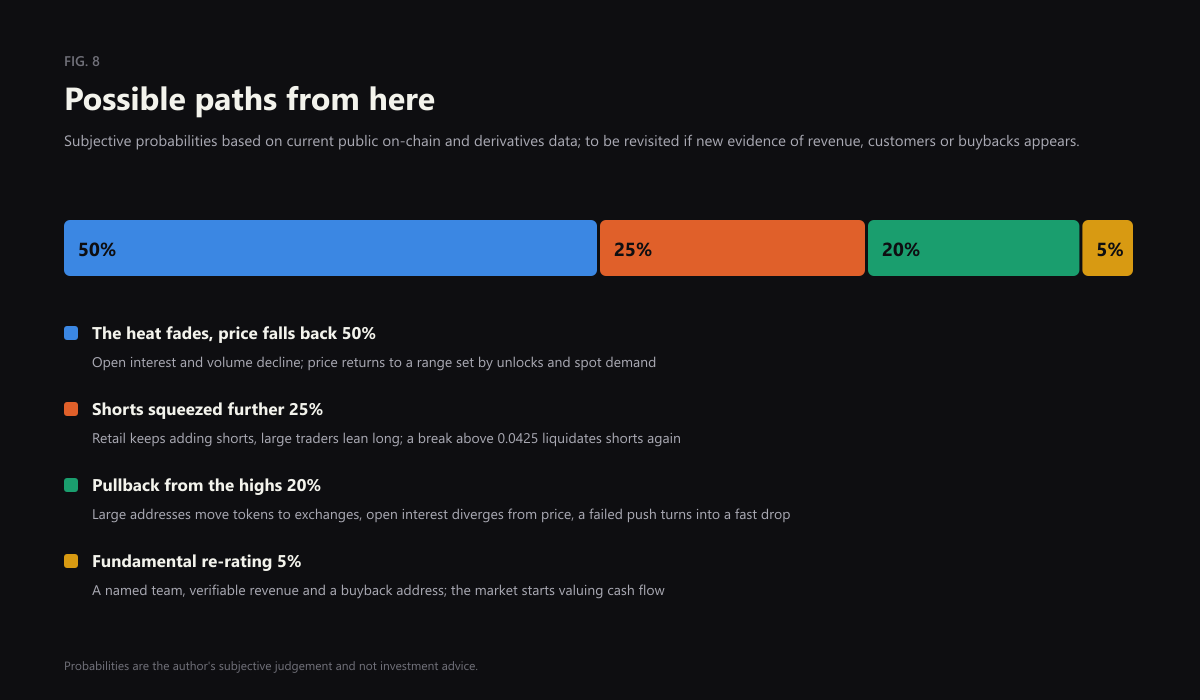
- The heat fades and price falls back (about 50%): open interest and volume decline, and price returns to a range set by unlocks and spot demand.
- Shorts get squeezed further (about 25%): retail keeps adding shorts while large traders lean long; a break above 0.0425 triggers another round of short liquidations. That only means there is still fuel for liquidations, not that fundamentals improved.
- A pullback from the highs (about 20%): large addresses move tokens to exchanges, open interest diverges from price, and a failed push higher turns into a fast drop. Once the 556 million tokens mentioned above start moving, the odds of this scenario rise sharply.
- A fundamental re-rating (about 5%): the project publishes a named team, verifiable revenue and a buyback address.
What to watch
- The top ten addresses and the 18 release recipients: any outgoing transfer should be traced, and a move to an exchange signals rising risk.
- The operations wallet
0x3b84…f2f3and distribution wallet0xbece…50b3: whoever they send gas to is about to move. - Depth in the main PancakeSwap pool: if the price stays high while depth falls, the risk of wicks rises.
- Binance perpetual data: rising price, rising open interest, retail adding shorts and large traders leaning long is the combination for further squeezes; a high price with falling open interest and large addresses moving to exchanges is the combination for a top.
- The five long wallets on Aster: once they close and withdraw USDT back to Bybit, the main force behind this leg is usually leaving.
Final word
AGT’s biggest danger is not the lack of a product. It is that the supply sits with one entity, free to move at any time, while the price is set on a perpetual order book only a few hundred dollars deep. This time those tokens did not move and the price was pushed up on perpetuals; but once they start moving, the market does not have the depth to take them.
Betting on direction in a structure like this is costly: an asset with poor fundamentals can still rise several times in a short squeeze, and being right in the long run does not help if you are liquidated on the way. A more reliable signal than sentiment is when the addresses listed above start sending tokens to exchanges.
This analysis is based on public data and is not investment advice.