In one line
The first four lessons were about the derivatives market: who is crowded, who is paying, whether money is arriving or leaving, and where the price is made. This lesson covers the other half: where the tokens on spot come from. For small tokens, the biggest spot sellers are usually the project itself and its early investors. Their tokens unlock on a schedule and then pass through a chain of issuer wallets to an exchange. Trace that route and you know where supply is queuing.
Three terms that get mixed up
- Circulating supply: third-party sites count it differently. ICNT shows 36% circulating on CoinGecko, but part of that has unlocked and still sits in the project’s own multisigs, not in the market.
- Unlocks: scheduled releases from a lock contract. Once unlocked, tokens are in the hands of the project or beneficiaries, who decide when, and whether, to sell.
- Issuer wallets: the minting address, lock contracts, multisigs, relay wallets and any other address traceable to the project. Most carry no public label; each has to be confirmed from on-chain transfers.
How to trace a route
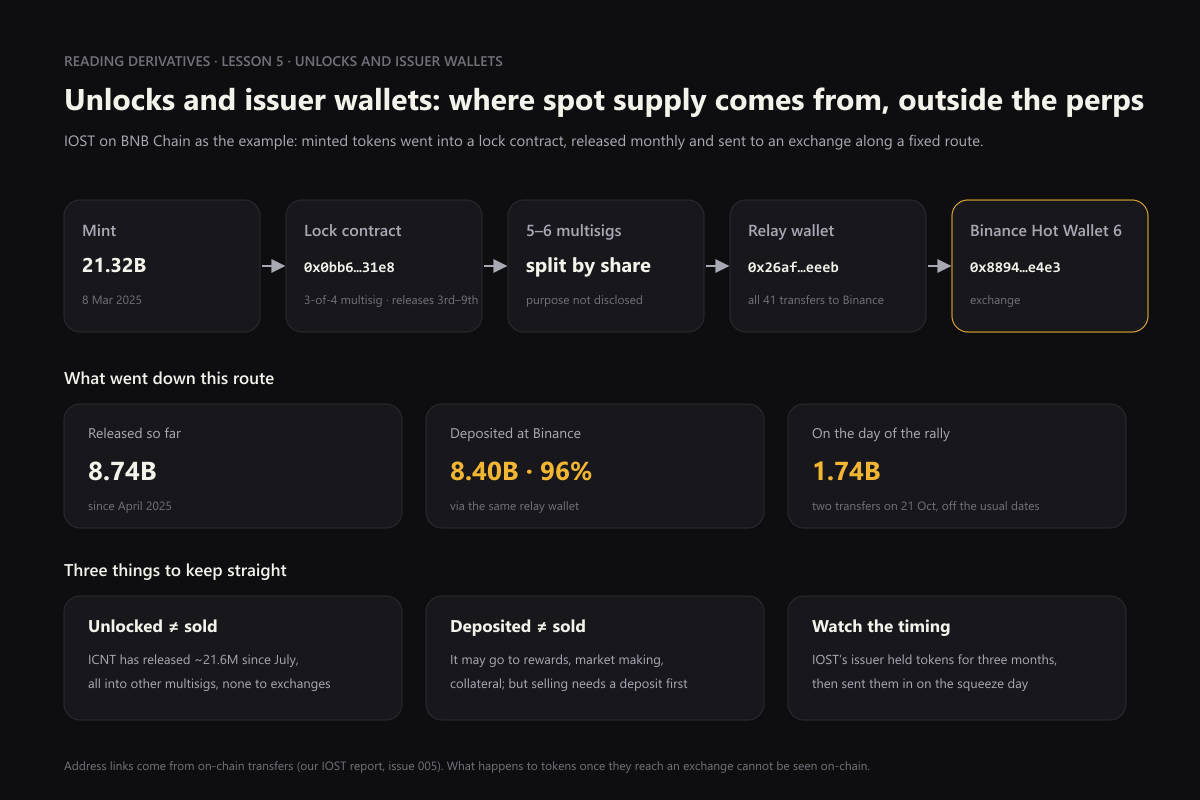
Take issue 005, IOST (the BNB Chain token). The route rests on this evidence:
- The mint: on 8 March 2025 the token contract minted 21.32 billion tokens to the contract’s creator; five minutes later the whole 21.32 billion went into a lock contract.
- The lock contract itself: it holds only IOST and is owned by a 3-of-4 multisig; since April 2025 it has released tokens once a month, between the 3rd and the 9th.
- Split and destination: each release is split in fixed shares across five (later six) multisigs, which every month pass the tokens to the same ordinary wallet; all 41 of that wallet’s outgoing transfers went to a Binance hot wallet.
- Checking against public information: 21.32 billion, unlocking monthly to 2030, matches the issuance plan reported by third parties.
The result: the lock contract has released 8.74 billion tokens, and 8.40 billion, about 96%, reached Binance along this route.
The timing matters most
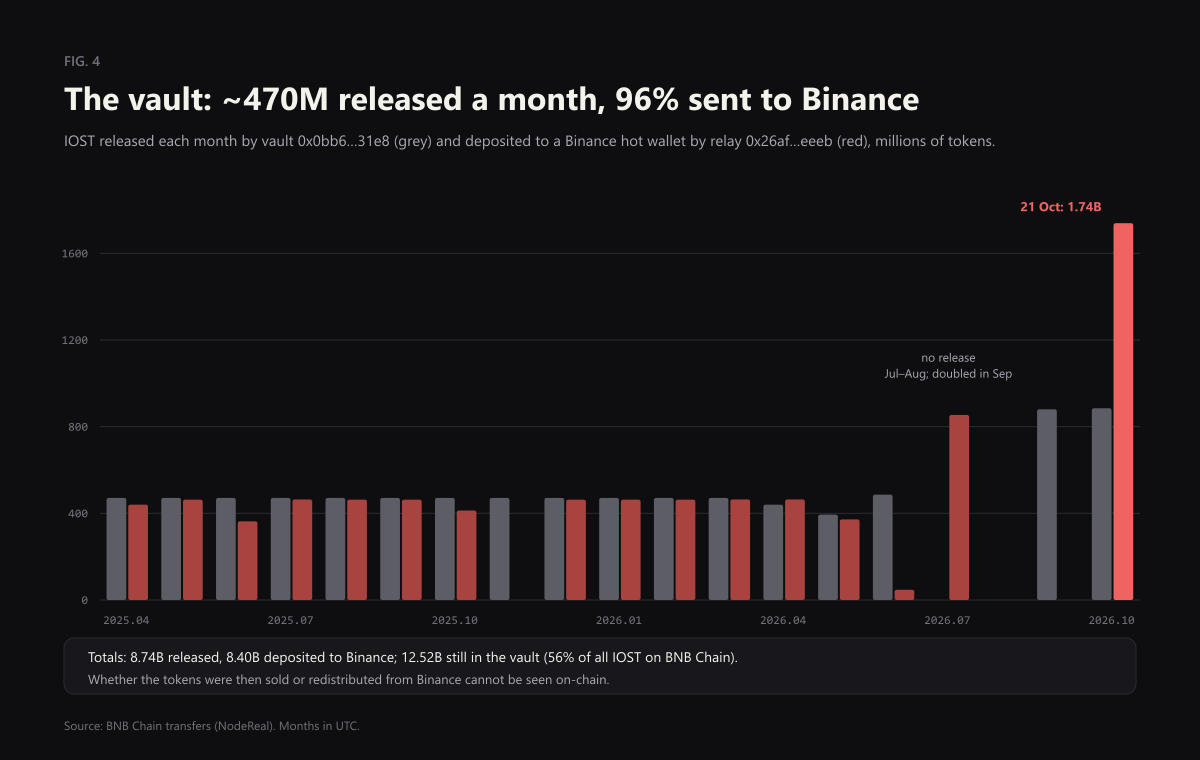
The route is usually regular. On 21 October it was not:
- the lock contract released nothing in July or August, then released two months’ worth on 9 September, which stayed in the multisigs. From 7 July to 21 October, nothing went from this route to Binance;
- on 21 October, after the price had risen from 0.00075 to 0.00126, two transfers at 08:43 and 13:13 sent 1.74 billion tokens to Binance, about $2.38M, roughly 4.8% of IOST’s circulating supply;
- the date was outside the usual 3rd–9th window, and it was the very day the price doubled, deposits were paused and the perp was squeezed.
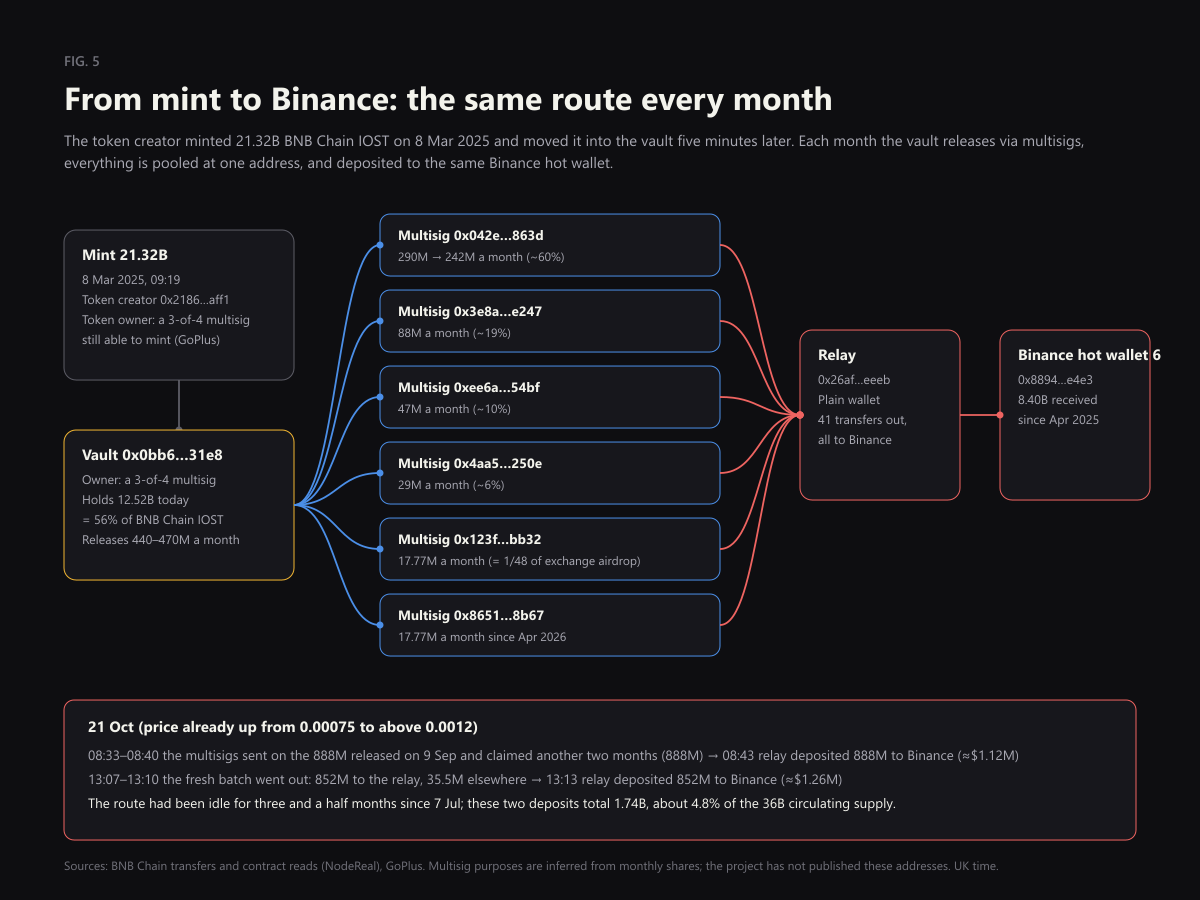
Whether those tokens were sold on Binance or used for rewards cannot be seen on-chain. But tokens held for over three months, sent in together on the day of the rally: the timing is information in itself.
Contrast: ICNT’s unlocked tokens stayed in multisigs
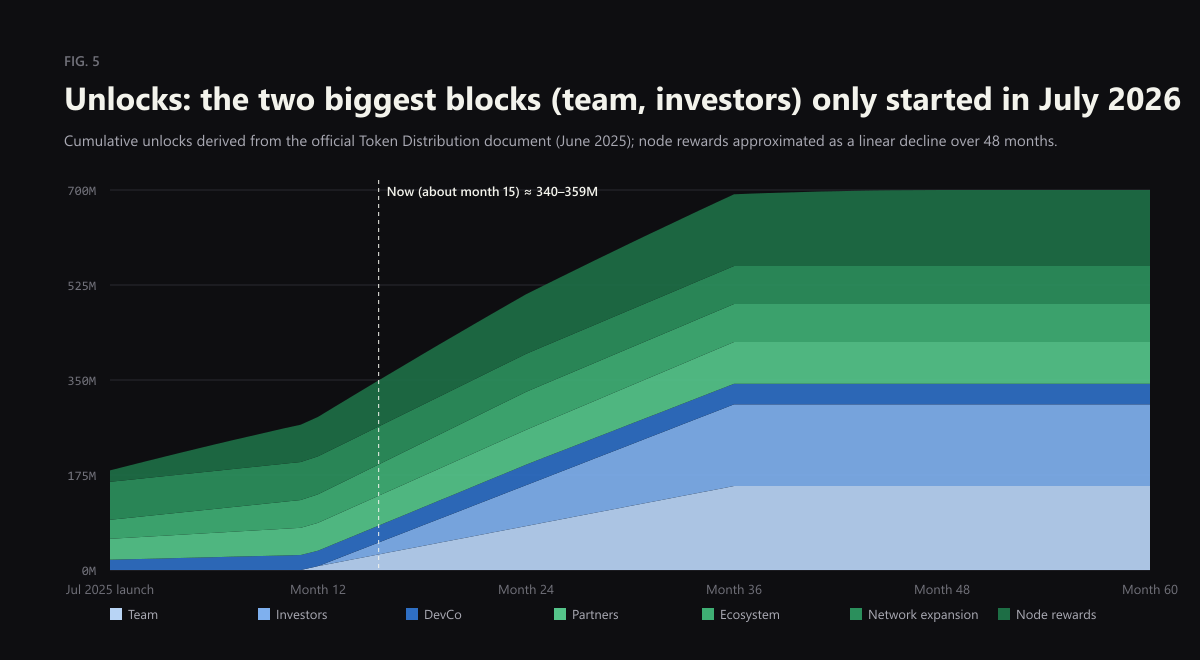
In issue 002, ICNT, team and investor tokens began unlocking monthly in July 2026; with the other categories, about 18M tokens a month are scheduled. On-chain, the roughly 21.6M released since July all went into other multisigs, none directly to exchanges, and during October’s perp-driven doubling the project’s wallets sent nothing to exchanges either.
Both are “unlocking”, but IOST’s tokens take a route straight to an exchange while ICNT’s are still parked in multisigs. An unlock calendar cannot tell these apart; only the on-chain destination can.
Common mistakes
- “Unlocks mean a dump.” An unlock only moves tokens from a lock contract to the project or beneficiaries. In ICNT’s case, the unlocked tokens never reached an exchange.
- “Deposited at an exchange means sold.” Not necessarily either. Tokens on an exchange may fund rewards, market making or collateral. But selling on an exchange usually requires a deposit first, which is why issuer wallets sending to exchanges is the signal most worth recording.
- “Issuer wallets haven’t moved, so there is no selling pressure.” Only if you have found all the issuer wallets. Many carry no label, and third-party “team holdings” figures often miss some.
Now look at the wallet tracker
The wallet tracker checks the issuer wallets of every project we have investigated each hour, records each transfer between them and exchanges, and shows how much each project sent to exchanges over the last 12 months. The nine addresses on IOST’s route are included. Read it alongside the derivatives board and you have both halves of this series: who is pushing the price on perps, and who is supplying tokens to spot.
In short: unlocked is not sold, and deposited is not sold either; but when and by which route a project’s tokens reach an exchange is the most direct clue to spot supply.
This article only explains what the measure means and how to read it. It is not investment advice and makes no buy, sell, leverage or position-size suggestions. Links between issuer wallets come from on-chain transfers; where an address has no label, its attribution is our inference.
The board refreshes every 15 minutes and the wallet tracker every hour. Both describe the market only and never suggest a trade.