
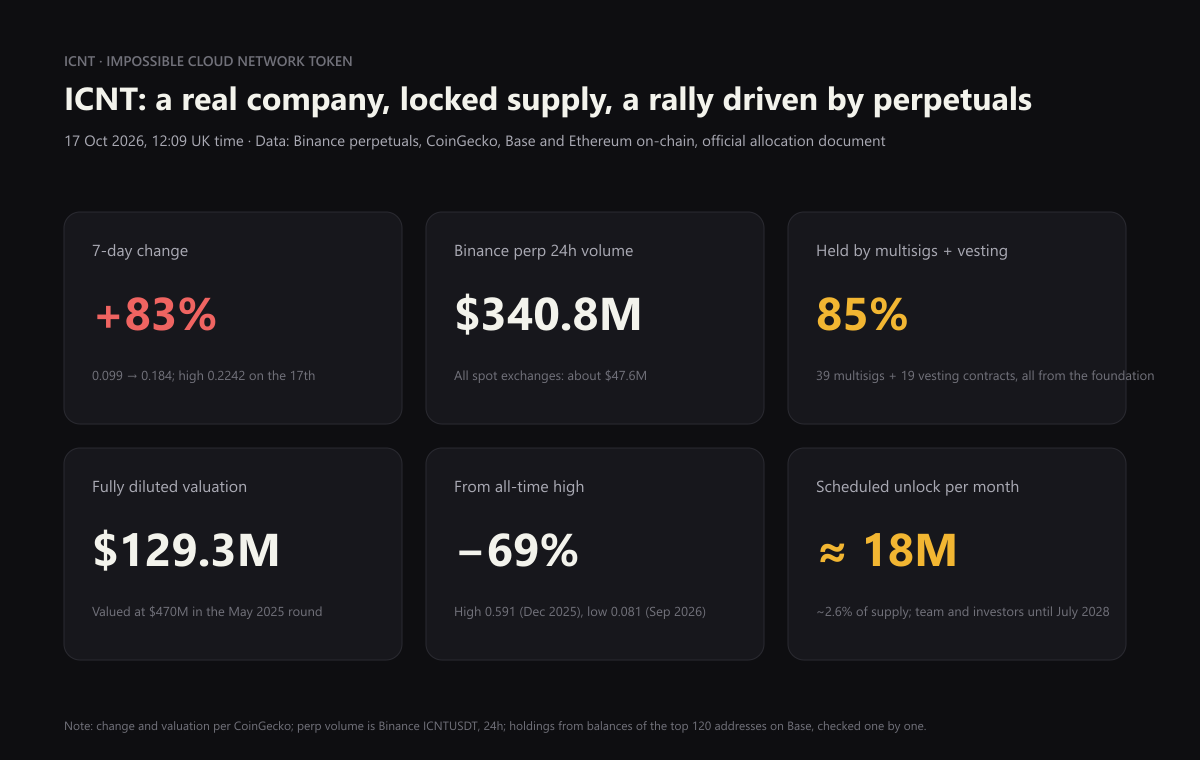
- The company behind it, Impossible Cloud, is a real cloud-storage business (Hamburg, founded 2021); the token is issued by a foundation in Zug, Switzerland; the team and investors are named
- About 85% of the 700 million tokens sit in 39 multisigs and 19 vesting contracts, all funded from the foundation's minting multisig; very little actually circulates in the market
- Team and investor tokens started unlocking monthly in July 2026: about 12 million a month per the official allocation table, and about 18 million including other categories
- Binance perpetual volume on 16–17 October was $400 million, 6–20 times all spot trading; project wallets did not send tokens to exchanges during the rally
Subject: the ICNT contract
0xe0Cd4cAcDdcBF4f36e845407CE53E87717b6601don Base (native Ethereum contract0xe5e0b73380181273abCfD88695F52C4D0C825661), and the Binance ICNTUSDT perpetual. Times are UK time. On-chain data comes from Base and Ethereum nodes and Blockscout, derivatives data from Binance’s public API, and project information from the official allocation document and MiCA white paper.
The short version
1. This is not an anonymous project. Behind it is Impossible Cloud, a company founded in Hamburg in 2021 that genuinely sells cloud storage. The token is issued by the Impossible Cloud Network Foundation in Zug, Switzerland, which filed a white paper under the EU’s MiCA rules. In May 2025, NGP Capital led a $34 million round at a $470 million post-money valuation. Unlike AGT in our previous issue, the team, company and funding can all be verified.
2. But nearly all the tokens are in project hands. About 85% of the 700 million tokens sit in 39 multisig wallets and 19 vesting contracts, all funded from the multisig the foundation used to mint the entire supply in 2024. Exchanges, on-chain pools and ordinary addresses together hold only about a tenth.
3. Selling pressure is lined up. Per the official allocation document, the team and investors hold 305 million tokens (43.6%). After a 12-month cliff, they unlock monthly from July 2026 to July 2028, about 12 million a month. Including partners, ecosystem, node rewards and others, about 18 million tokens are scheduled to unlock each month, roughly $3.4 million at the current price.
4. October’s doubling was driven by perpetuals. Binance ICNTUSDT perpetual volume was $180 million on 16 October and $220 million on the 17th, against only a few million a day before. All spot exchanges combined traded a few million to just over $30 million a day over the same period. During the rally, the project’s multisigs and vesting contracts did not send tokens to exchanges.
What ICNT is
Impossible Cloud Network (ICN) aims to build a “decentralised cloud”: hardware providers connect servers to the network, cloud service providers pay in ICNT for compute and storage, and hardware providers stake ICNT as collateral for service quality, which can be slashed (token page, MiCA white paper). The network runs on Base, with a fixed supply of 700 million tokens.
There are two entities here, and they should be kept apart:
- Impossible Cloud GmbH: a Hamburg cloud-storage company. Object storage is publicly priced from €7.99 per TB per month; it claims more than 3,000 business customers and ISO 27001 certification (company website). The company website does not mention ICNT.
- Impossible Cloud Network Foundation: a foundation registered in Zug, Switzerland on 17 October 2024 and the issuer of ICNT. The white paper lists its council as Nathan Kaiser (president), Mathieu Chanson and Sebastian Pfeiffer.
The ICN website claims “$7M+ ecosystem ARR” and “1,000+ enterprise clients”. These are self-reported figures and have not been independently audited.
Team and funding: verifiable
- Founder Kai Wawrzinek previously founded the games company Goodgame Studios; co-founder Christian Kaul held roles at Groupon and Airbnb (company press release, company blog).
- In May 2025, NGP Capital led a round of about $34 million at a post-money valuation above $470 million, with 1kx, Protocol Labs, HV Capital and others participating (Decrypt, The Defiant).
- The fully diluted valuation is now about $129 million, roughly 70% below that round’s valuation.
Price: down 86% in 15 months, then doubled
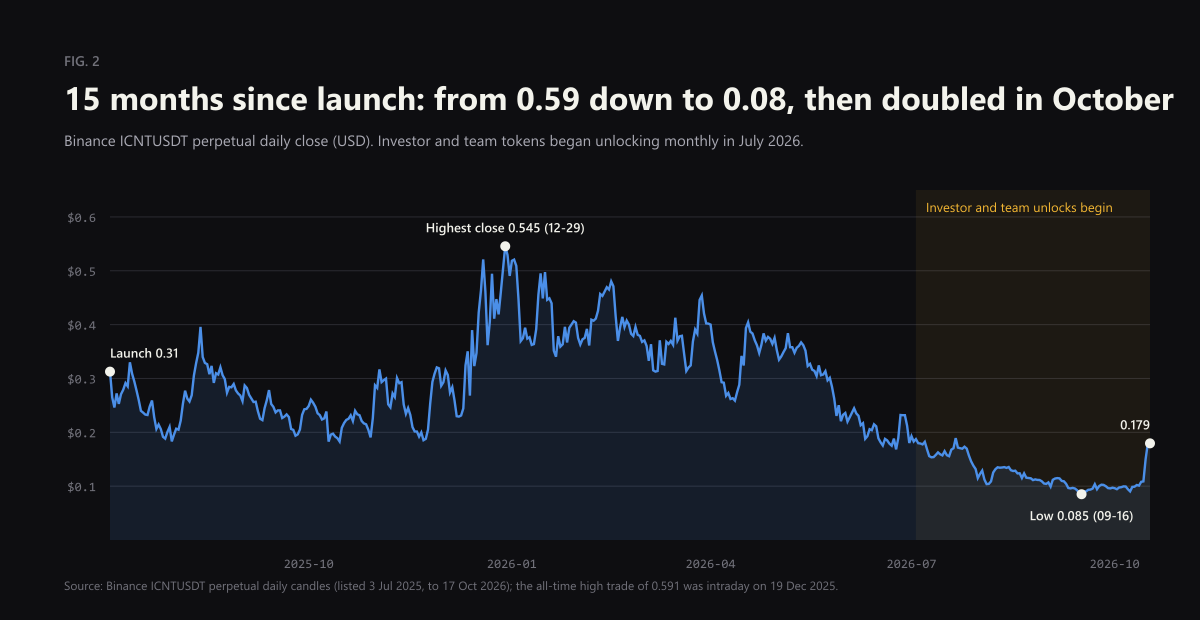
ICNT launched on 3 July 2025, the same day Binance listed a perpetual. It reached 0.591 intraday on 19 December 2025, then slid to a low of 0.081 on 16 September 2026, down 86%. Team and investor tokens began unlocking monthly in July 2026, during the second half of that decline.
In October it rallied from around 0.10 to an intraday high of 0.224 on the 17th, and was around 0.18 at 12:09, up 83% in seven days.
Holdings: 85% in multisigs and vesting contracts
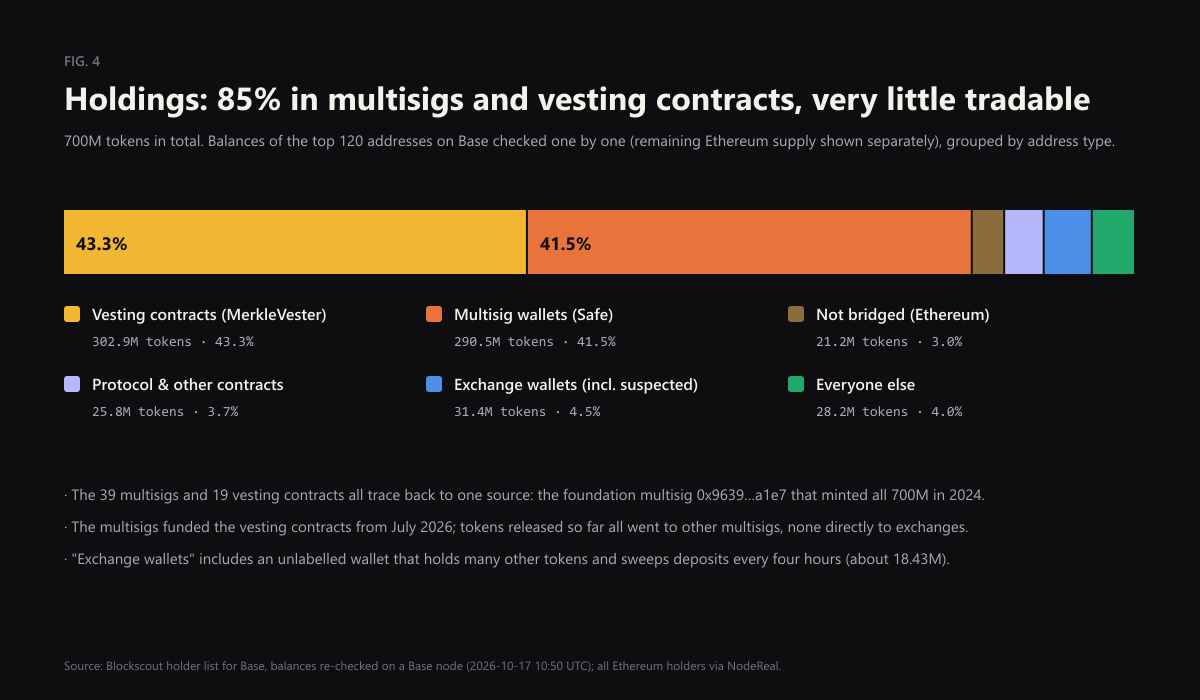
All 700 million tokens were minted in one go on Ethereum on 5 August 2024 to the foundation multisig 0x9639ca93c72bf5ca536148ab0199170b83e4a1e7. On 28 May 2025 this multisig bridged 655 million tokens to Base through Base’s official bridge, and between 30 May and 13 June distributed them to dozens of new multisigs, in amounts matching the official allocation table: for example 140 million (node rewards), 70 million and 35 million, plus several transfers of 23.49M, 17.82M and 16.40M.
We checked the balances of the top 120 addresses on Base one by one:
- 19 vesting contracts (MerkleVester) hold about 303 million tokens (43.3%). The multisigs funded them from July 2026 onwards, and they release monthly;
- 39 multisig wallets (Safe) hold about 290 million (41.5%);
- About 21 million that were never bridged remain on Ethereum mainnet, mostly in multisigs too;
- Exchange wallets (including suspected ones) hold about 31 million, protocol contracts about 26 million, and ordinary addresses about 28 million.
CoinGecko shows 253 million tokens (36%) in circulation, more than is actually in the market on-chain, because tokens that have unlocked but still sit in the project’s own multisigs are counted as circulating. “Unlocked” does not mean “sold”: when and how much of it gets sold is up to the project and each beneficiary.
Unlocks: the two biggest blocks have only just started
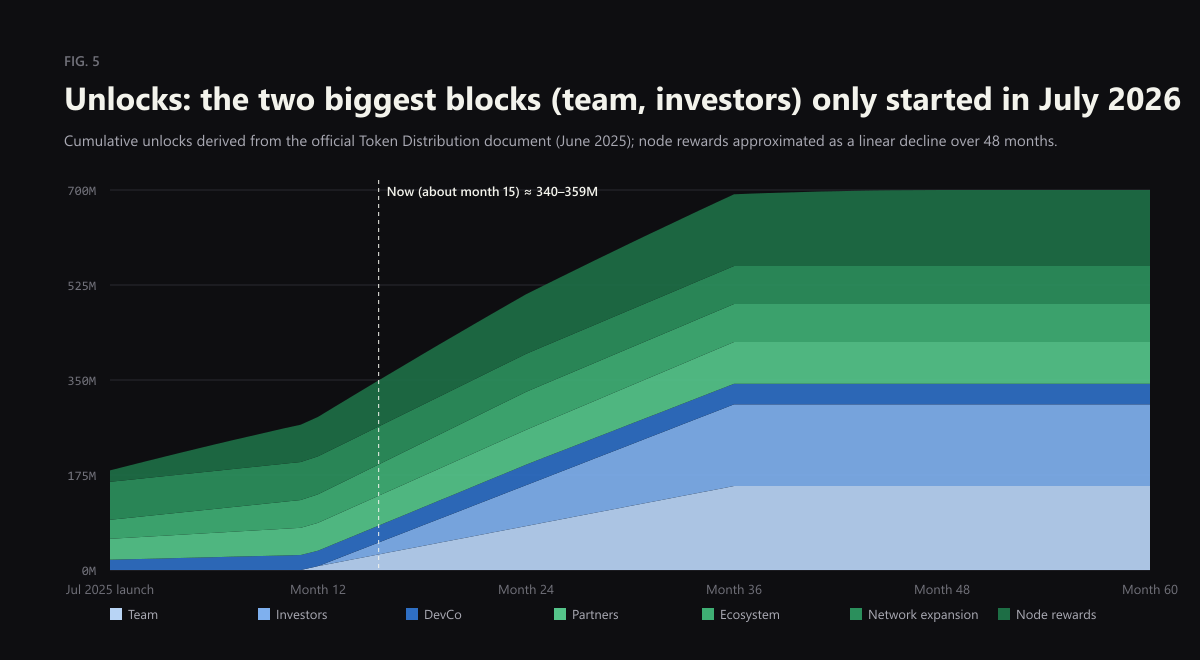
Per the official Token Distribution document (June 2025, PDF):
| Category | Amount | Release |
|---|---|---|
| Team | 154.7M (22.1%) | 12-month cliff, then 24 months linear |
| Investors | 150.5M (21.5%) | 12-month cliff, then 24 months linear |
| Node rewards | 140M (20%) | 21M at launch, the rest declining over 48 months |
| Partners | 77M (11%) | Half at launch, the rest linear over 36 months |
| Ecosystem development | 70M (10%) | Half at launch, the rest linear over 24 months |
| Network expansion | 70M (10%) | Fully unlocked at launch |
| Development company (DevCo) | 37.8M (5.4%) | Half at launch, the rest linear over 24 months |
Team and investors together release about 12 million tokens a month from July 2026 until July 2028. Including other categories, about 18 million are scheduled each month, roughly 2.6% of supply.
What the chain shows: since July, the vesting contracts have released about 21.6 million tokens, all into other multisigs, none directly to exchanges. Who owns those multisigs and what happens next is not labelled on-chain and cannot be confirmed.
The MiCA white paper also states that, at the time, the foundation itself still held 356 million tokens (about 51%) in its treasury.
The action is on perpetuals
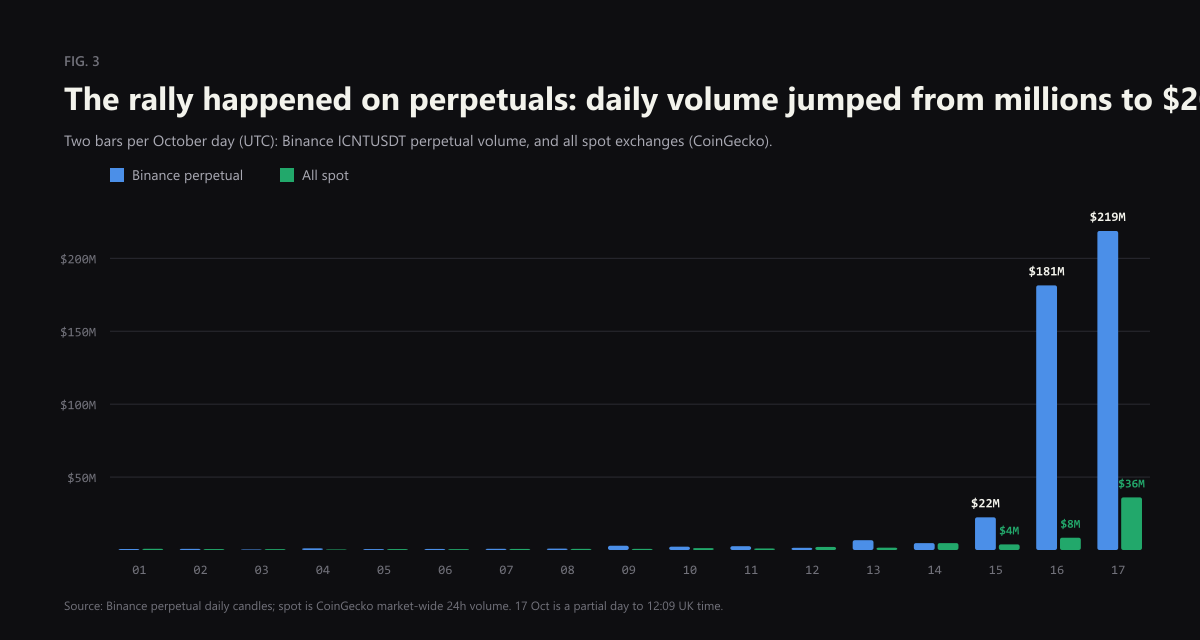
From 1 to 14 October, the Binance ICNTUSDT perpetual traded $1–7 million a day. Volume rose to $22 million on the 15th, $180 million on the 16th and $220 million by midday on the 17th. All spot exchanges combined traded a few million to just over $30 million a day over the same period; the largest spot market was the Korean won pair on Bithumb (ICNT reportedly listed on Bithumb in July 2026).
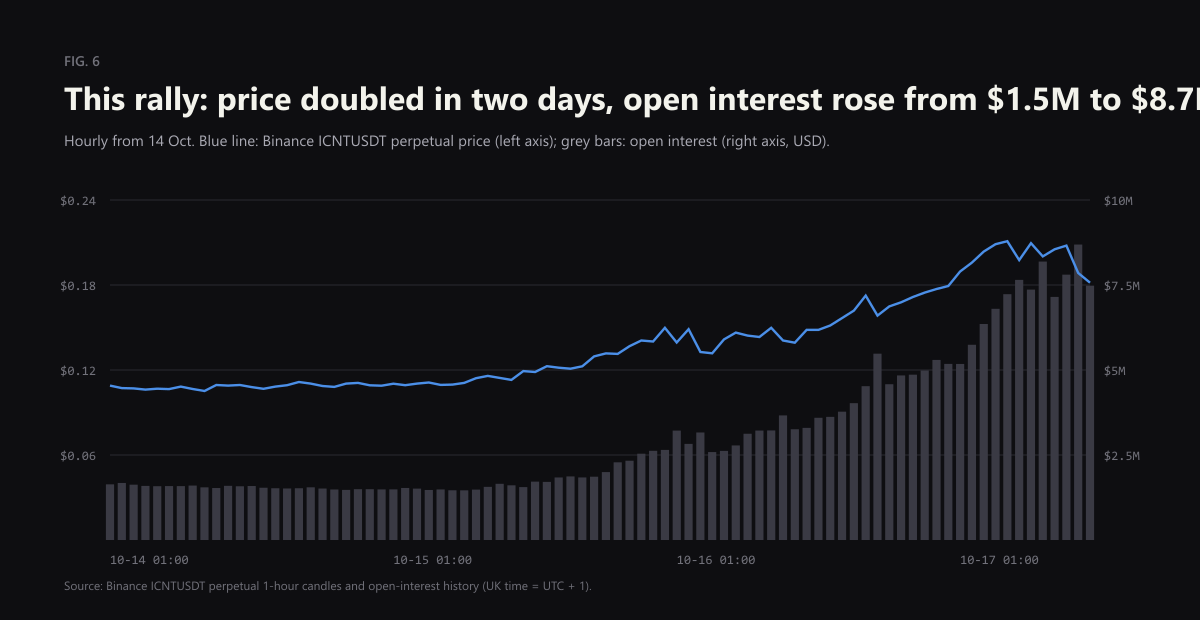
Open interest rose from about $1.5 million on 14 October to a peak of about $8.7 million on the 17th. Unlike AGT, ICNT’s funding rate was negative most of the way up (−0.039% at the 09:00 settlement on 17 October), meaning more traders were short and shorts were paying longs. The retail account long/short ratio was between 1.0 and 1.4 and the top-trader position ratio around 1.0, so neither side dominated.
Open interest is small in absolute terms, but compare it with spot: for a token with very little on-chain float and only a few million dollars of daily volume, $400 million of perpetual volume in two days makes it easy for derivatives money to push the price.
What happened on-chain during the rally
- Project wallets did not send tokens to exchanges. We checked the 70 largest non-exchange holders (covering every multisig and vesting contract with more than 500,000 tokens). In October only one multisig moved anything, about 680,000 tokens on the 12th, to an ordinary address. Nothing went directly to an exchange.
- A transfer that “looked like accumulation” was more likely an exchange moving its own funds. On 1 October, Bitget’s hot wallet sent 11.18 million tokens to an address that first appeared on 29 September. That address then swept incoming ICNT to another address every four hours, 25 million in total. But both addresses also hold more than 10 million USDC, hundreds of ETH and many other Base tokens, and their deposits come from small wallets all gas-funded by the same address: the typical structure of exchange deposits and sweeps, not a single whale accumulating. Which exchange it is, the chain does not say.
- An allocation at launch. In the week around launch (26 June to 4 July 2025), a project multisig sent about 36 million tokens to more than a dozen addresses. The largest transfer, 8.75 million on 2 July, went to
0x93deb693b170d56bdde1b0a5222b14c0f885d976, which then forwarded 7 million to0x73d8bd54f7cf5fab43fe4ef40a62d390644946db. Third-party pages show the first address as one of the largest holders of many Binance Alpha and airdrop tokens, and a news report says tokens pass through it before reaching Binance wallets. The tokens of the ninth-largest AGT holder in our previous issue also came from this address. It is very likely an address used for exchange listings or airdrop distribution, but its owner cannot be confirmed on-chain.
Transparency issues
We found no court ruling, regulatory action or credible investigative report establishing wrongdoing by ICN. Issues supported by public materials:
- No verifiable link between company revenue and the token. The company website does not mention ICNT; the “$7M ecosystem ARR” is unaudited, and there is no visible way revenue flows back to the token (no buybacks, burns or traceable fee addresses).
- Wallet use is undisclosed. 85% of the tokens sit in dozens of multisigs and vesting contracts, and there is no official list of which belong to the team, which to investors and which is the foundation treasury.
- Official materials contradict each other. The website’s token page contains, in its source code, an allocation table that is not displayed; labels and numbers such as “investors 70M, DevCo 140M” do not match the official PDF, and the percentages add up to more than 100%.
- A loose definition of circulating supply. Third-party circulating figures are far higher than what is actually in the market on-chain.
Multi-dimension scores
- Poor 0–3
- Fair 4–6
- Good 7–10
Higher is better (a low “derivatives structure” score means higher risk). The team and product are clearly stronger than AGT’s; what pulls the score down is the token itself: weak value capture, concentrated holdings and unlocks under way.
Possible paths from here
- The heat fades and price falls back (about 45%): perpetual volume and open interest return to a few million dollars a day, and price settles in a range set by unlocks and spot demand.
- Shorts get squeezed further (about 25%): funding stays negative and open interest keeps rising; a break above 0.224 could trigger another round of short covering. That only means there is still fuel in the derivatives market, not that fundamentals changed.
- Unlocked tokens are sold into strength (about 25%): project multisigs or beneficiary addresses start sending tokens to exchanges. With about 18 million tokens scheduled to unlock each month, a high price meeting retreating perpetual money would mean a fast pullback.
- A fundamental re-rating (about 5%): the project discloses a link between revenue and the token (such as fee addresses or buybacks), or network usage data becomes independently verifiable.
What to watch
- The 58 project multisigs and vesting contracts: any transfer to an exchange signals that unlocked tokens are being sold. The three largest multisigs are
0xe1c7…a02c(82.87M),0x2a86…1414(50.90M) and0x42e2…cf8b(32.96M). - Where the monthly vesting releases go: for now they all go to multisigs; the month they start going straight to exchanges is when the selling pressure becomes real.
- Binance perpetual data: volume, open interest and funding. Funding turning positive, falling open interest and a stalling price together mark the end of this derivatives-driven move.
- Korean won volume on Bithumb: it is the largest source of spot buying; if it dries up, spot support weakens.
Final word
ICNT is not the same kind of project as AGT: it has a named team, a real company, institutional funding and regulatory filings. Its risk is not about “who is behind it” but about the token itself. There is no visible link between what the company earns and the token; 85% of the 700 million tokens are in the hands of the project and investors; the two largest blocks are unlocking monthly; and the price was pushed up by derivatives money on a very thin float.
A good company does not make a good token. The most reliable signal for how far this rally can go is not news or calls on social media, but when those dozens of project wallets start sending tokens to exchanges.
This analysis is based on public data and is not investment advice.
Sources and data
- ICN website · Token page · Impossible Cloud company website
- Official token distribution document (June 2025) · MiCA white paper
- Decrypt: NGP Capital leads round · The Defiant: mainnet and token launch · crypto.news: Binance Alpha, Kraken and KuCoin listings
- BitcoinWorld: Bithumb lists ICNT for KRW trading
- Blockscout contract page (Base) · Etherscan contract page (Ethereum) · CoinGecko