
Live figures are for reference; numbers in the article are as of publication. Not investment advice.
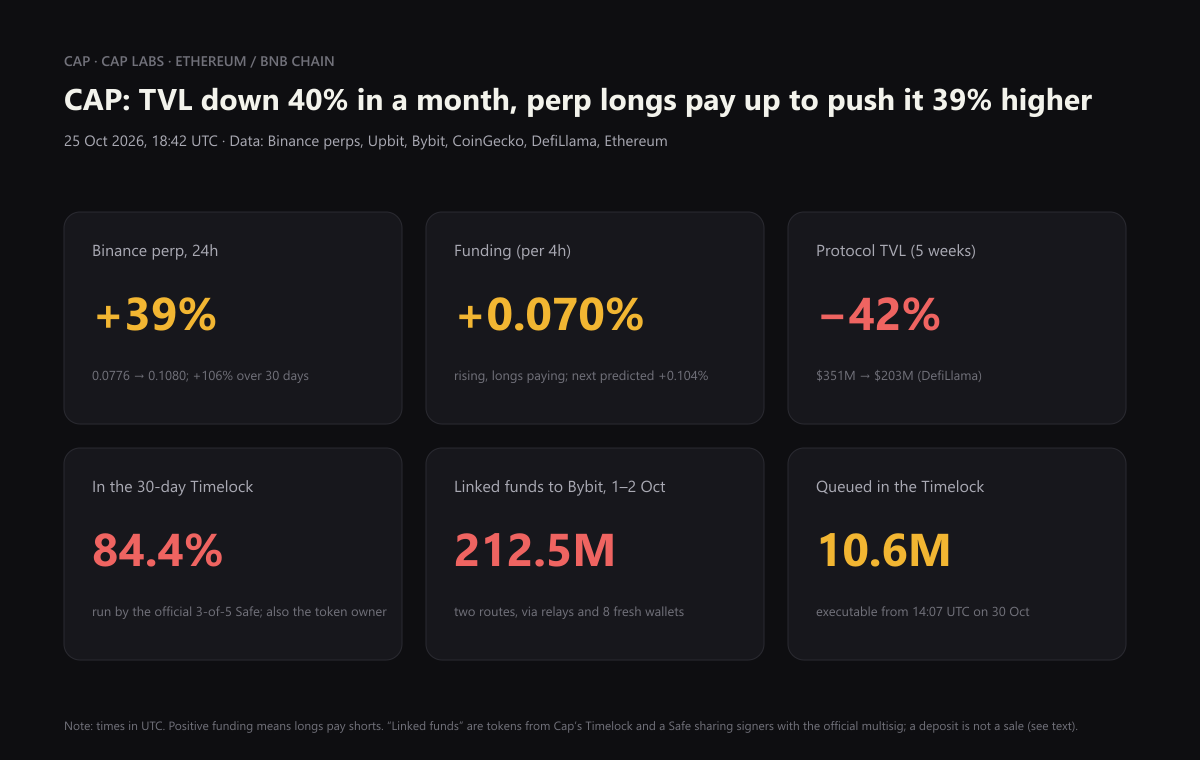
- Two legs: a gentle rise from 12:00 UTC on 24 October, then the main leg from 07:00 to 17:00 on the 25th, with Binance perps trading $4.7M–$22.8M an hour and peaking at 0.11172; +39% over 24 hours (0.0776 → 0.1080), +106% over 30 days. We found no listing, product or partnership news
- Perp-led, with Korean spot following: Binance perps traded $175M in 24 hours, 1.57 times all spot ($111M); open interest rose 81% to $24.9M. Funding climbed from 0.005% to +0.070% per 4 hours, with longs paying; the all-account long/short ratio fell from 1.57 to 0.98 while the top-trader position ratio stayed at 1.82
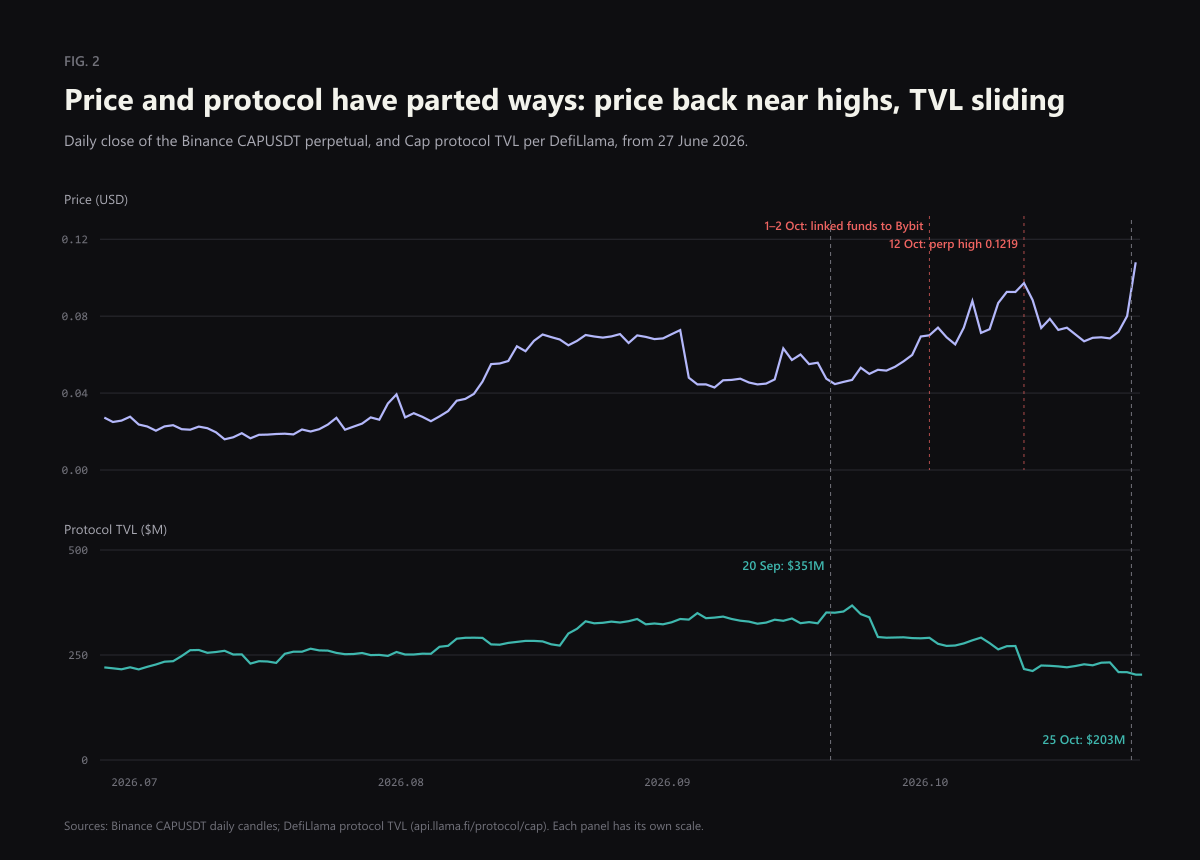
- Fundamentals did not follow: DefiLlama shows protocol TVL down from $351M on 20 September to $203M on 25 October (−42%)
- 84.4% of the 10B supply is in a 30-day Timelock run by the official 3-of-5 multisig. On 1 October, 12.5M released by the Timelock reached Bybit within 46 minutes via three hops; on 2 October a linked multisig's 200M was split across 8 fresh wallets and deposited at Bybit; another 10.625M can be executed from 14:07 on 30 October. None of these addresses moved in the last 72 hours
Subject: CAP, the token of Cap Labs. The contract address is the same on Ethereum and BNB Chain:
0x99991c6aabba5a096f24f250b73580f5179b9999; total supply 10B, with the BNB Chain version bridged via LayerZero. Price and derivatives data come from the public APIs of Binance, Upbit and Bybit and from CoinGecko; TVL from DefiLlama; on-chain data from 35 days of Ethereum transfers, Timelock events and contract reads. All times are UTC.
The short version
1. Perp-led, Korean spot following, longs paying. The price drifted up from 12:00 on 24 October, then ran from 07:00 to 17:00 on the 25th to a high of 0.11172: +39% over 24 hours, +106% over 30 days. Binance lists no CAP spot; Binance perps traded $175M in a day, 1.57 times all spot ($111M), and open interest rose 81% to $24.9M. Funding climbed from 0.005% to +0.070% per 4 hours: longs paying to stay in. Retail accounts, though, were turning short: the all-account long/short ratio fell from 1.57 to 0.98, while the top-trader position ratio stayed at 1.82.
2. Price and protocol have parted ways. Cap runs on-chain credit backed by “financial guarantees” and a stablecoin, cUSD. DefiLlama shows protocol TVL falling from $351M on 20 September to $203M on 25 October (−42%), while the price more than doubled. We found no listing, product or partnership news behind this move.
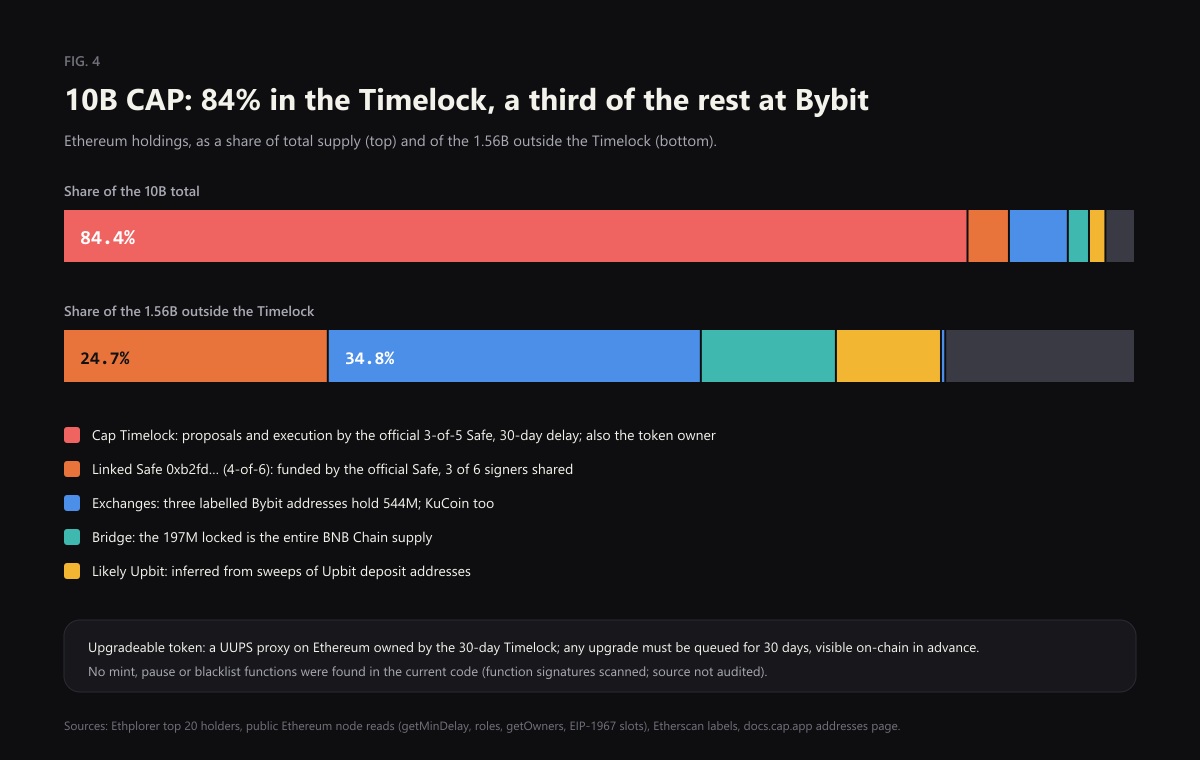
3. 84.4% sits in a 30-day Timelock. The Timelock owns the token contract, and proposals and execution belong to the 3-of-5 multisig published in the official docs. Another 3.9% sits in a 4-of-6 multisig that shares three signers with the official one. Together the issuer and the linked multisig control about 88%.
4. Two routes took 212.5M to Bybit in early October, and another release is queued. On 1 October, 12.5M released by the Timelock passed through three relays and reached a Bybit deposit address within 46 minutes. On 2 October, 200M that the linked multisig had sent out a month earlier was split across 8 fresh wallets and all deposited at Bybit. On 30 September the Timelock queued another 10.625M, executable from 14:07 on 30 October. None of these addresses moved in the last 72 hours, and a deposit is not a sale.
What CAP is
Cap is an on-chain credit protocol: users deposit dollar assets for cUSD, the reserves are lent to institutions for yield, and each loan has to be underwritten in Cap’s guarantee market. A $8M seed round in April 2025 was led by Franklin Templeton, with Susquehanna, GSR and Nomura’s Laser Digital among others; the public auction cleared at $0.011, a $106M FDV.
- Listing: trading began on 26 June 2026, with Binance Alpha the same day and the Binance perp on 27 June. Binance has no CAP spot; Upbit listed it on 6 August, and Bithumb, Bybit, Kraken, Coinbase and KuCoin all have spot.
- Supply: 10B, of which 1.56B (15.6%) circulates. Official allocation: ecosystem and community 47.37%, private investors ≤20%, team ≤20%, public sale 5%, others. Private, team and Echo allocations release 25% at 12 months after TGE, then monthly over three years; third-party trackers put the first cliff at 26 June 2027, about 1.08B tokens. The ecosystem and community share has no public schedule.
- Earlier moves: since listing, CAP has had several high-volume spikes followed by pullbacks (14 Aug, 14 Sep, 19 Sep, 6 Oct, 12 Oct); the perp high was 0.1219 on 12 October.
Perps: open interest and funding rising together
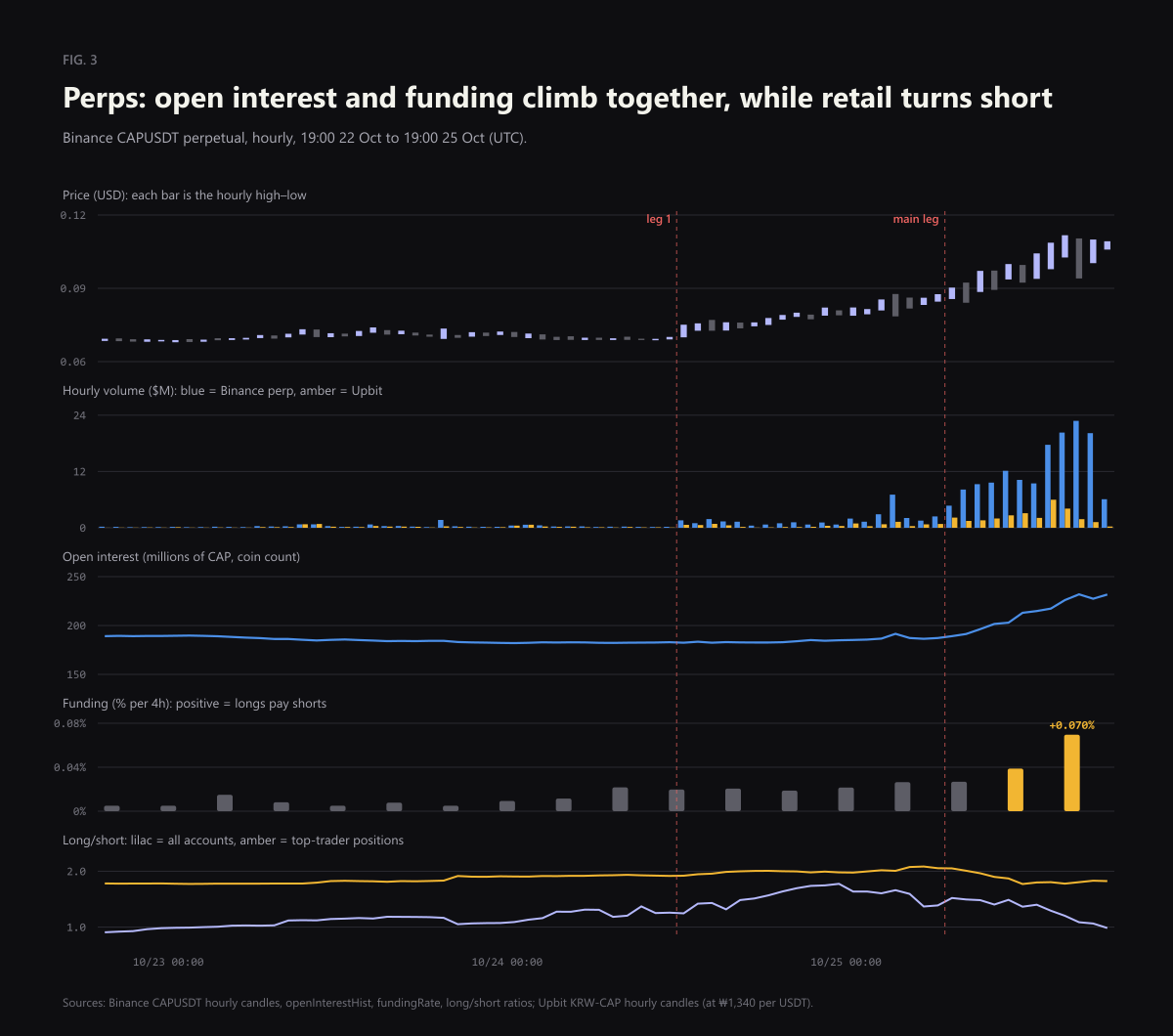
- Start: the 12:00 hour on 24 October went from 0.06994 to 0.07339 on $1.58M, against $0.1–0.3M an hour before; from 07:00 on the 25th volume ran $4.7M, $8.2M … up to $22.8M an hour, touching 0.11172 at 15:00 before a 16% drop to 0.09404 in the 16:00 hour.
- Volume: Binance perps $175M in 24 hours, Bybit perps $42.3M; all spot $111M, including Upbit $39.3M, Bybit spot $15.7M, PancakeSwap on BNB Chain $13.6M and Bithumb $9.0M. The two Korean exchanges were 43.5% of spot. Upbit traded about 1.2% below Binance: no Korea premium.
- Open interest: flat at 182–189M tokens from 22 October to 06:00 on the 25th, then rising fast from 07:00 to 232M at 18:00 ($24.9M), about 15% of the float. +27% in coins and +81% in dollars over 24 hours. Bybit perp open interest rose 39% over the same period.
- Funding: 0.005% from 20 to 22 October, rising from the 23rd to +0.0696% at 16:00 on the 25th (the highest in 200 settlements), with +0.104% predicted next. Longs are paying more and more.
- Long/short: all accounts 1.57 → 0.98 (long accounts 61% → 50%); top-trader positions 2.01 → 1.82, long throughout. Taker buy/sell around 1.0, no one-sided buying.
This is the opposite of the other two tokens this round: on APR and T, shorts were being squeezed; on CAP, longs are paying up, open interest is growing and big positions lean long, while retail accounts drift short as the price rises. On a perp book with about $100k of depth within ±1%, $24.9M of open interest unwinding at once would move the price a lot; the 16% drop in the 16:00 hour was one example.
Holders: 84% in the Timelock, a third of the float at Bybit
| Address | Holds | Share | Notes |
|---|---|---|---|
Cap Timelock 0x0000…c3da…b709 |
8.44B | 84.4% | 30-day delay; proposer and executor are the official 3-of-5 multisig 0x80A2…; also the token contract’s owner |
Linked multisig 0xb2fd…fd75 (4-of-6) |
386M | 3.9% | Received 586M from the official multisig on 30 June; 3 of its 6 signers are official signers |
| Three labelled Bybit addresses | 544M | 5.4% | About 35% of the 1.56B outside the Timelock |
| Bridge lock | 197M | 2.0% | Exactly the entire BNB Chain supply |
| Likely Upbit (inferred from flows) | 153M | 1.5% | Receives sweeps from many “Upbit Deposit” addresses; no official label |
The contract can be upgraded, but only after 30 days in the queue. CAP on Ethereum is a UUPS proxy owned by the 30-day Timelock; the BNB Chain version is a LayerZero token owned by a one-day Timelock, also executed by the official multisig. We found no mint, pause or blacklist function in the current code (function signatures scanned; source not audited). The upside: any upgrade or release has to be queued on-chain 30 days in advance, where anyone can see it.
Flows: two routes into Bybit
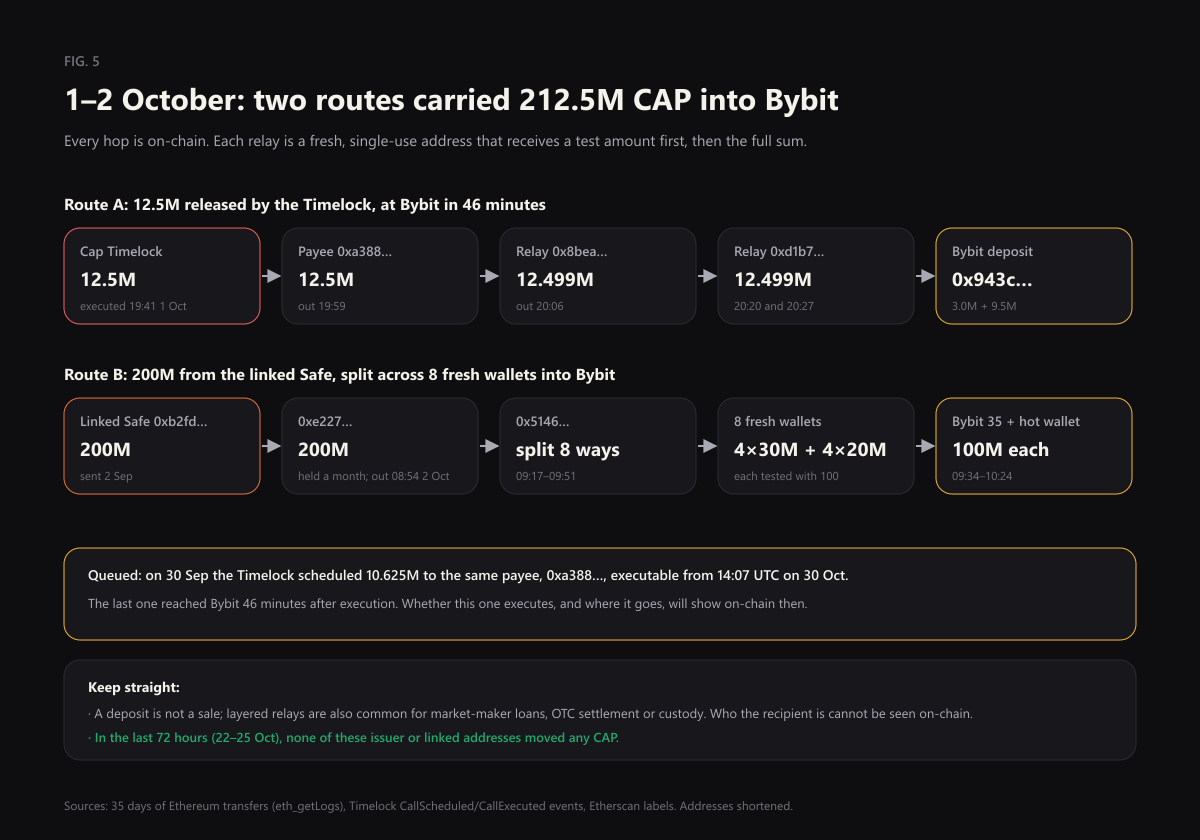
Route A: 12.5M released by the Timelock, at Bybit in 46 minutes. Queued on 1 September and executed at 19:41 on 1 October, the Timelock sent the tokens to payee 0xa388…; at 19:59 they went to 0x8bea…, at 20:06 to 0xd1b7…, each hop preceded by a 1,000-token test; at 20:20 and 20:27 two transfers totalling 12.4999M reached an address Etherscan labels “ByBit Deposit”. Between 20:00 and 23:00 that evening the price fell from 0.0840 to 0.0700.
Route B: the linked multisig’s 200M, split across 8 fresh wallets into Bybit. On 2 September the linked multisig 0xb2fd… sent 200M to 0xe227…, where it sat for a month. At 08:54 on 2 October it moved to 0x5146…, which split it across 8 new addresses at 09:17–09:51 (four of 30M, four of 20M, each receiving a 100-token test first); between 09:34 and 10:24 all of it went to Bybit, 100M each to Bybit 35 and the Bybit hot wallet. That morning the price slid from 0.0678 to a low of 0.0591 in the 12:00 hour before bouncing to 0.076. Coinciding in time is not causation.
The queued release. At 14:07 on 30 September the Timelock queued “transfer 10.625M to 0xa388…”, executable from 14:07 UTC on 30 October. The previous one reached Bybit 46 minutes after execution.
Things to keep straight:
- A deposit is not a sale. Layered relays with test transfers first are also common for market-maker loans, OTC settlement or custody, and the recipient cannot be identified on-chain. The official market-maker allocation is only 0.6% (60M), so 200M more likely came from the ecosystem and community share, but this is unconfirmed.
- In the last 72 hours (19:10 on 22 October to 19:10 on the 25th), the Timelock, the official multisig, the linked multisig, the deployer and all the relays above moved no CAP.
- From 13 to 25 October about 110M left Bybit for a few new addresses and has not moved since. Exchange bookkeeping breaks the on-chain trail, so these cannot be called the same tokens that went in on 2 October.
Scorecard
- Poor 0–3
- Fair 4–6
- Good 7–10
Higher is better (a low “derivatives structure” means higher risk). Cap has a real product, known backers and published multisig and signer addresses, which is better than most small tokens. What pulls the score down: falling TVL, 88% of supply under the issuer and a linked multisig, the ability to queue releases at any time, and some released tokens reaching an exchange quickly.
Possible paths from here
- Crowded longs unwind (about 45%): funding is at its highest in 200 settlements, open interest is growing and the book is thin. Without fundamentals behind it, this setup usually ends with a concentrated unwind; CAP has already had five spike-and-fade episodes since listing.
- A push towards the 12 October high (about 25%): big positions lean long and Korean spot is active, so it could run further short-term. That says money is pushing, not that the protocol is improving.
- Issuer releases reach exchanges (about 25%): 10.625M becomes executable on 30 October, and 84% is still in the Timelock, with any new queue visible 30 days ahead. Releases that quickly reach exchanges would add supply at high prices.
- A fundamental change (about 5%): TVL stabilising and recovering, or buybacks actually happening.
What to watch
- Funding, open interest and long/short on the Binance CAP perp: funding still rising while the price stalls and open interest starts falling is the combination that ends these moves.
- Timelock
0x0000…c3da…b709queue events: whether the 30 October release executes and where it goes; any new release or upgrade queued. - Payee
0xa388…and linked multisig0xb2fd…: transfers to exchanges would signal issuer-related tokens entering the market. - Protocol TVL on DefiLlama: whether the gap between rising price and falling TVL closes.
Finally
CAP differs from APR and T this round: here, longs paid ever-higher funding on the perp to push the price up, rather than shorts being squeezed. The protocol is real, with known backers and public multisigs, but TVL lost 40% in a month while the price doubled.
What is most worth recording on-chain are the two routes from the Timelock and the linked multisig: each hop a fresh, single-use address, tested, filled, emptied, ending at Bybit. They did not move during this rally, but the Timelock still holds 84% of supply and a release is already queued for 30 October. For a token like this, the Timelock queue is worth more attention than the price.
This is an analysis of public data, not investment advice.
Sources
- Binance CAPUSDT public APIs: hourly and daily candles, openInterestHist, fundingRate, long/short and taker ratios, order book depth; Binance spot exchangeInfo (no CAP); the Binance Alpha token list
- Other exchanges: Upbit, Bithumb and Bybit public tickers; CoinGecko; DefiLlama
- On-chain: 35 days of Ethereum transfers (eth_getLogs), Timelock CallScheduled/CallExecuted events, multisig getOwners and proxy storage reads; Ethplorer/Binplorer holders; Etherscan labels; GoPlus
- Project: docs.cap.app tokenomics · docs.cap.app addresses · Tokenomics.com
- Coverage: The Block (seed round) · The Defiant (auction) · Phemex Academy