
- The official allocation table matches the chain exactly: the community airdrop, team, ecosystem fund and investor allocations all came from one distribution wallet, and every monthly community and ecosystem release went to the project's own hub wallet
- At 17:48 on 14 April, mid-crash, tokens the hub wallet had sent out in March passed through two layers of fresh addresses and reached Gate in the same second, 37.05 million in total, close in time and size to the sell-off flagged by on-chain analyst EmberCN
- Between 12:14 and 12:31 on 14 October, the 680 million tokens left in the team, investor, community, ecosystem and hub wallets all moved into five multisigs created that day; gas for all five came from Gate withdrawals in the same minute
- About 81% of ARIA sits in addresses traceable to the project's distribution wallet; in October's rally, Binance perpetual volume was about six times all spot trading combined
Subject: the ARIA contract
0x5d3A12C42E5372B2CC3264AB3cdcF660a1555238(AriaAI) on BNB Chain, and the Binance ARIAUSDT perpetual. Times are UK time. On-chain data comes from BNB Chain transfer records, derivatives data from Binance’s public API, and the allocation table from the project’s official docs.
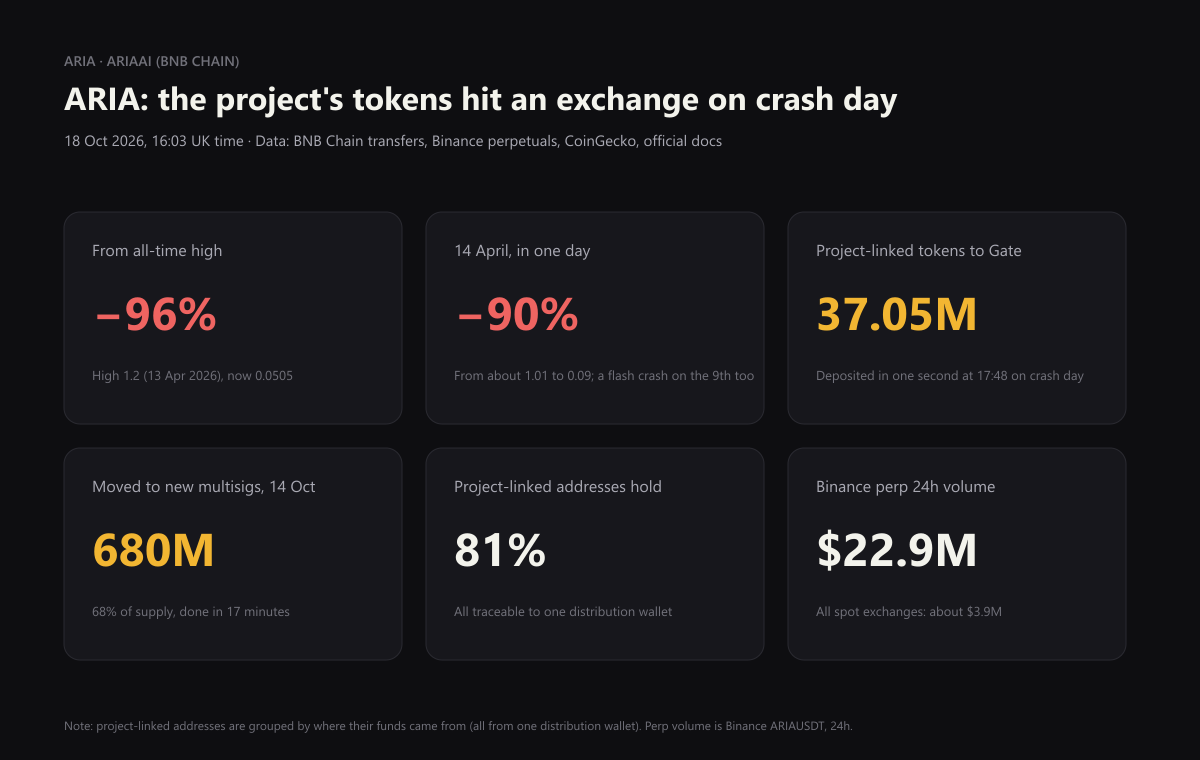
The short version
1. The official allocation table matches the chain line by line, which makes the trail easy to follow. All 1 billion tokens came from one distribution wallet, and the amounts and release schedules for the community airdrop, team, ecosystem fund and investors match the official docs. But the tokens released each month for the community airdrop and the ecosystem fund were not sent to users. Every release went to one hub wallet controlled by the project.
2. On crash day, tokens that had left the project’s hub wallet reached an exchange. On 15 March the hub wallet sent 90 million tokens to five new wallets. On 7 April two of them split their tokens into two single-use addresses. At 17:48 on 14 April those two addresses deposited a combined 37.05 million tokens to Gate, one second apart. By then ARIA had already fallen from 1.01 earlier that day to 0.19, and it went on to 0.09.
3. On 14 October, the remaining 68% moved in 17 minutes. The 680 million tokens left in the team, investor, community airdrop, ecosystem fund and hub wallets were transferred into five multisig wallets created that same day. Gas for all five multisigs was withdrawn from Gate in the same minute. The project has said nothing about the move.
4. About 81% of ARIA now sits in addresses traceable to the project’s distribution wallet. Third-party trackers show 183 million tokens (18.3%) in circulation, but very little is actually spread across the market. In October’s move from 0.033 to 0.05, Binance perpetual volume was about six times all spot trading combined.
What ARIA is
AriaAI describes itself as a game-publishing experiment combining “Disney-style immersive worlds” with AI. Its advertised products include a Telegram mini-game, an RPG mobile game, AI characters powered by MyShell and an AR app (official docs). ARIA is a BNB Chain token used, according to the docs, for governance votes, in-game spending and AI usage.
- Team: neither the website nor the docs name anyone. Media reports mention backers such as Galaxy and Animoca Brands (TradersUnion); we found no formal investment announcement.
- Listings: launched around 21 August 2025 on Gate, Bitget, KuCoin and other exchanges, and on Binance Alpha. Binance listed an ARIAUSDT perpetual on 3 September 2025. Binance does not list ARIA spot.
- Contract code: open source, no minting, ownership renounced, no transfer tax or blacklist (GoPlus). The risk is in who holds the supply, not in the code.
Price: up more than tenfold in a month, down 90% in a day
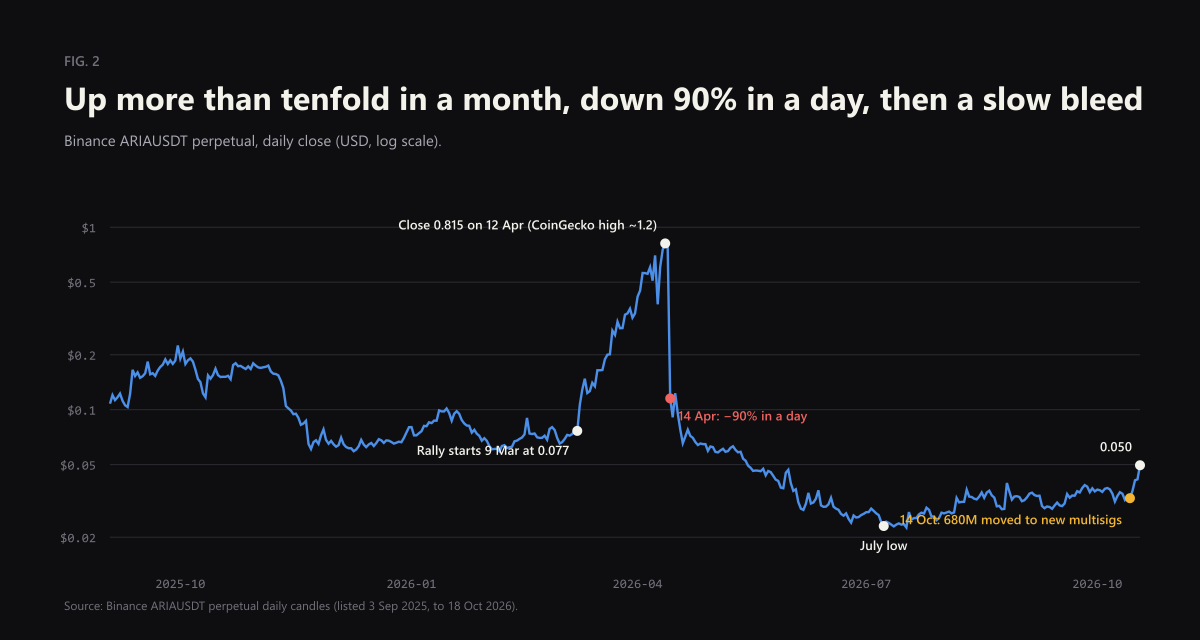
- Before 9 March 2026, ARIA traded around 0.07 with less than $2M of perpetual volume a day. From 9 March it rallied on heavy volume, closing at 0.815 on 12 April. CoinGecko recorded a high of about 1.2 on 13 April (the Binance perpetual peaked at 1.03): more than tenfold in just over a month, with perpetual volume above $1 billion on the busiest day.
- In the 11:00 hour on 9 April, the price flash-crashed from 0.706 to 0.059 and recovered to 0.4 the same day. An auditor had just described ARIA’s code as a “black box” that was not fully verified (CryptoTimes).
- On 14 April, the price fell from an intraday high of about 1.01 to 0.09, a drop of roughly 90%, with the steepest part between 16:00 and 18:00 (Bitcoin.com).
- It then bled lower, hitting 0.022 on 8 July. At 16:03 on 18 October it was about 0.050, 96% below its all-time high.
The trail: from the official allocation to Gate
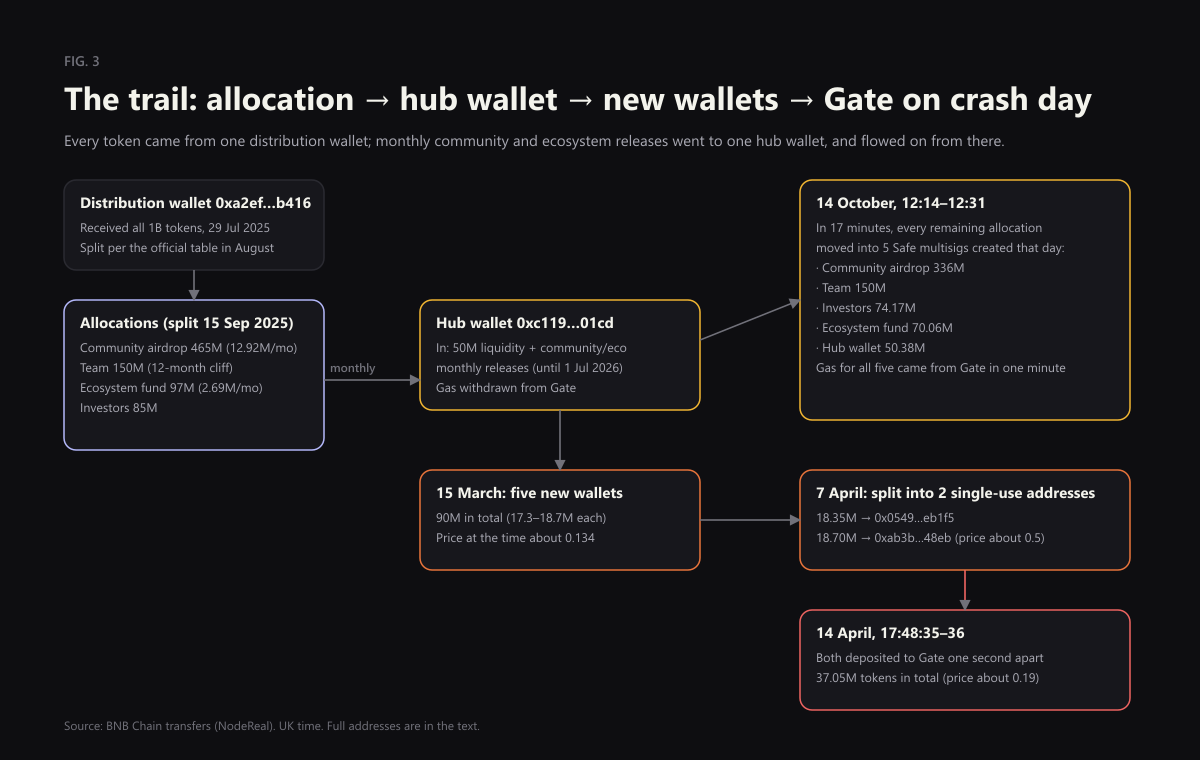
The allocation table maps one-to-one onto the chain
On 29 July 2025, all 1 billion tokens were minted to 0x77ac0ba04e0c37b2543b80430dc391eadb6bf211 and moved minutes later, in full, to the distribution wallet 0xa2ef06299cc399b022331a18d7292aae66d2b416. On 19 August the distribution wallet sent 806.5 million tokens to 0xd3a1d9acc95b18cf5776cff602f3348b57d604ed, which split them within one minute on 15 September:
| Address | Amount | Official allocation | Releases on-chain |
|---|---|---|---|
0x474771d24ff6d29a63d0f6f33182138040376d91 |
465M | Community airdrop (51%, after launch unlock) | 12.92M a month → hub wallet |
0xf88b45a8afc2dab1c1974691ec4923f57d5f02c1 |
150M | Team (15%) | 12-month cliff; never moved |
0x28efede96e1b5f3b0925648634d608b99b510890 |
97M | Ecosystem fund (9.7%) | 2.69M a month → hub wallet |
0x40f54e35b4e416a7338bf45168680b6443d8cef0 |
85M | Investors (8.5%) | 12-month cliff; 10.83M released on 16 Sep 2026 |
The official docs say the community airdrop is 51%, with 8.8% unlocked at launch and the rest released linearly over 36 months, and the ecosystem fund is 9.7%, released linearly over 36 months. 465M ÷ 36 = 12.92M and 97M ÷ 36 = 2.69M, exactly the monthly amounts seen on-chain.
The problem is where they went. From September 2025 to 1 July 2026, both monthly releases went every month to the same hub wallet, 0xc119d285e46b0c092b12b77c0afdf36d383d01cd. This wallet also received the 50 million “liquidity” allocation at launch, and its first gas came from a withdrawal from Gate’s hot wallet. Officially, the community airdrop “rewards the community and players”. On-chain, the tokens went into a project-controlled wallet.
15 March: 90 million tokens sent out
Between 17:30 and 18:40 on 15 March, the hub wallet sent between 17.3 and 18.7 million tokens to each of five brand-new addresses, 90 million in total, at a price of about 0.134. This happened partway through the rally that began on 9 March, before ARIA reached $1 in April.
7 April: split up; 14 April: deposited to Gate in the same second
- On 7 April, two of those addresses moved their tokens in six transfers into two new single-use addresses: 18.35M from
0xee9d48b6f4311d7a9e073dafe706fa17befa0ad7into0x05498a050fab4db513e32d33c7383666833eb1f5, and 18.70M from0xfe1e2797f7b5adc02d5c2aa8368475e888693303into0xab3bef2f25dba7353090f7f0873a8d5ba5f648eb. The price that day was about 0.5–0.6. - At 17:48:35 and 17:48:36 on 14 April, one second apart, these two single-use addresses deposited 18.70M and 18.35M tokens to Gate’s hot wallet
0x0d0707963952f2fba59dd06f2b425ace40b492fe, 37.05 million in total. Neither address ever sent any other transaction.
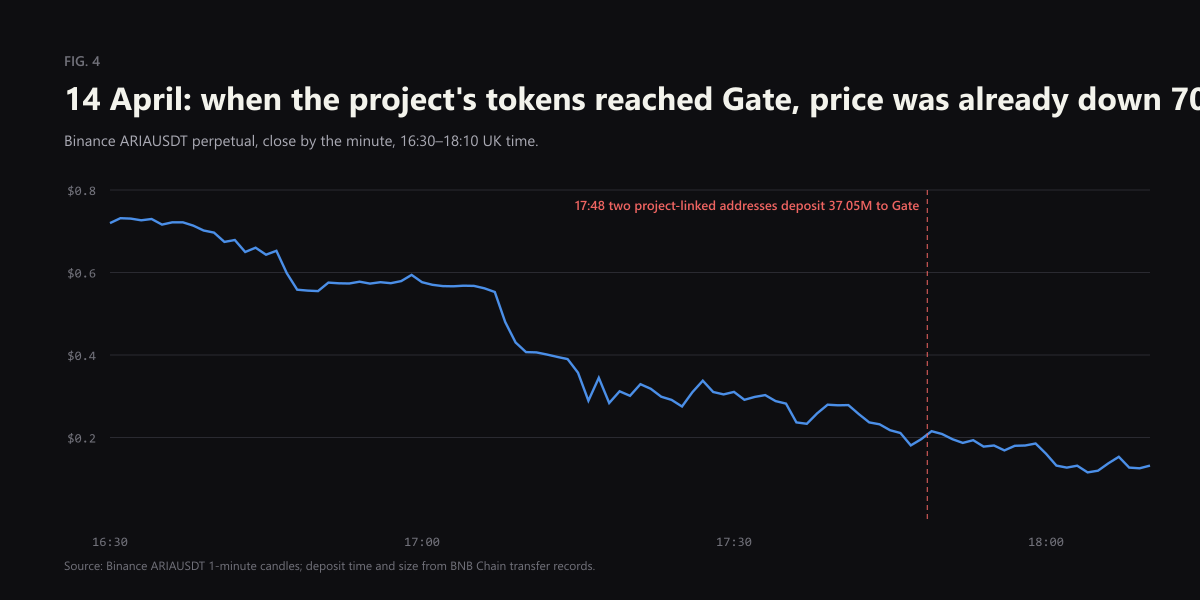
The deposits came in the middle of the crash: the price was still 0.72 at 16:30, had fallen to about 0.19 by 17:48, and dropped below 0.12 within the next hour.
At the time, on-chain analyst EmberCN alleged that eight wallets, likely controlled by one entity, sold 45.64 million ARIA on Gate for 5.42 million USDT at an average of about 0.12 (as reported by Bitcoin.com). 17:48 UK time is 00:48 on 15 April in Beijing, and the size is similar, so these 37.05 million tokens may be the bulk of that sale, but we cannot confirm it is the same batch. What we can confirm: these 37.05 million tokens came from the batch the project’s hub wallet sent out in March, and they were deposited to Gate on crash day. How much was sold after the deposit, and to whom, is not visible on-chain.
The other three wallets funded on 15 March: two still hold 18M and 17.65M tokens and have never sent a transaction; the third sent 10 million tokens, via an intermediary, to another exchange’s hot wallet in August and September 2026, and still holds 7.3M.
14 October: 680 million tokens moved in 17 minutes
- The monthly releases stopped after 1 July 2026: there were none in August or September. The team’s 150 million tokens completed their 12-month cliff in August, but did not start the advertised 36-month linear release.
- Around 11:44 on 14 October, someone created five Safe multisig wallets. At 11:55, within the same minute, each received about 0.005 BNB of gas, all withdrawn from Gate’s hot wallet.
- Between 12:14 and 12:31 the remaining allocations moved in one after another: the hub wallet’s 50.38M (12:14), the ecosystem fund’s 70.06M (12:20), the investors’ 74.17M (12:24), the community airdrop’s 336M (12:28) and the team’s 150M (12:31), 680 million tokens in total, 68% of supply. Each large transfer was preceded by a test transfer of a few tokens.
Moving tokens into multisigs is not bad in itself; projects often do it to tidy up treasury management or require several signers. But in this case: the project made no announcement; the 336 million community airdrop tokens have still not been given to users; the team allocation moved as one block instead of being released on schedule; and who signs for the new multisigs is not visible on-chain.
Holdings: about 81% on the project’s distribution trail
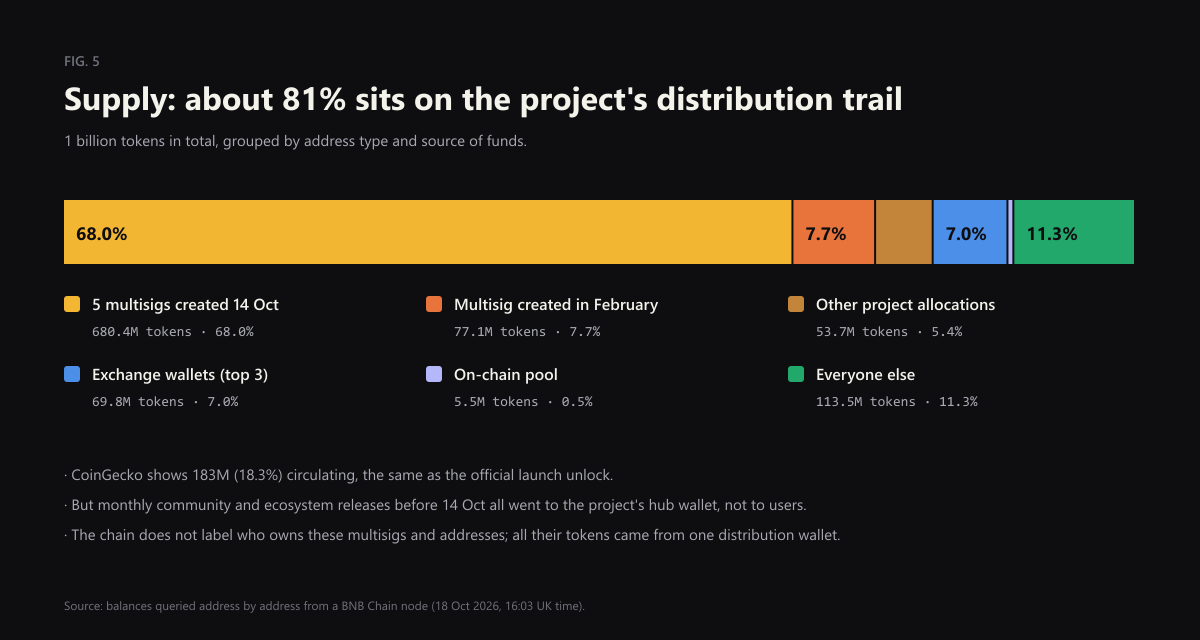
Balances at 16:03 on 18 October:
- The five multisigs created on 14 October: 680 million (68.0%);
- Another multisig,
0x6c343862e55ff091010432231268ba58a5b50fc4, funded on 25 February 2026 by the distribution wallet and others: 77.11 million (7.7%); - The wallets funded on 15 March and other early allocation addresses: 53.7 million (5.4%);
- Exchange wallets (a suspected Binance custody address, Gate, and another exchange): about 69.8 million (7.0%); the on-chain pool holds about 5.5 million.
In total, about 81% sits in addresses traceable to the project’s distribution wallet. There are more than 80,000 holder addresses, but most hold dust.
The action is on perpetuals
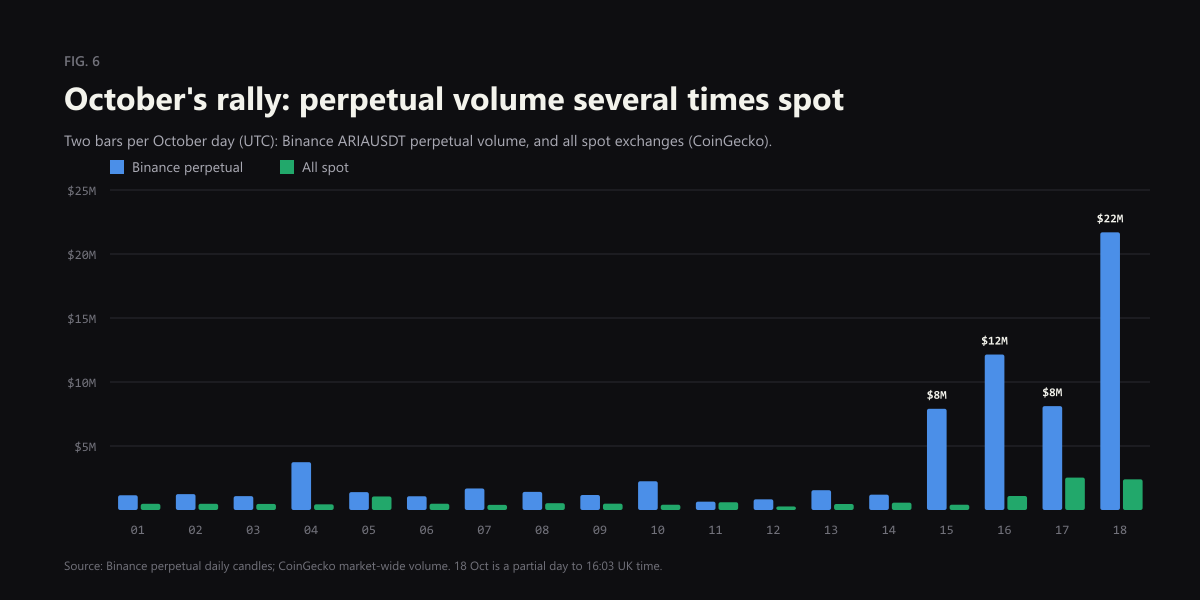
Before 14 October, the Binance ARIAUSDT perpetual traded $1–2M a day. Volume picked up from the 15th: $7.9M on the 15th, $12.1M on the 16th and more than $20M on the 18th by 16:03. All spot exchanges combined traded only a few million dollars a day over the same period; the largest spot markets were PancakeSwap and Gate. The price rose from 0.033 at the close on the 14th to 0.050, about 50%, with roughly $6.06M of open interest and funding close to zero.
Both April flash crashes also happened on perpetuals: $178M of perpetual volume in the 11:00 hour on 9 April, $520M on 14 April as a whole, when CoinGlass recorded about $11.9M of liquidations. On a spot market this thin, high-leverage perpetuals let a small amount of spot selling break through the price.
Transparency issues
We found no court ruling, regulatory action or credible investigative report establishing wrongdoing by AriaAI. Issues supported by public materials and on-chain data:
- The team is anonymous, and investor backing appears only in media reports;
- Community airdrop tokens went to a project wallet: officially for rewarding the community and players, on-chain every monthly release went to the project’s hub wallet;
- Project-linked tokens reached an exchange on crash day: 37.05 million deposited to Gate in the same second, with no explanation from the project;
- 68% of supply was moved as a block, with no announcement, and the team allocation was not released on schedule;
- Binance offers only perpetuals, not spot, so price is mostly set in the derivatives market.
Multi-dimension scores
- Poor 0–3
- Fair 4–6
- Good 7–10
Higher is better (a low “derivatives structure” score means higher risk). Apart from contract code safety, all nine other dimensions score 3 or below.
Possible paths from here
- The heat fades and price falls back (about 45%): perpetual volume and open interest return to $1–2M a day, and price drifts back towards 0.03.
- Tokens in the new multisigs start moving to exchanges (about 30%): 680 million tokens is several times the entire current spot float. Even a small share reaching exchanges would overwhelm current depth, and April could repeat.
- Perpetual money pushes it higher for a while (about 20%): with thin spot and rising perpetual volume, a short-term spike is still possible, but it would not reflect any change in fundamentals.
- The project explains itself (about 5%): publishes the purpose and signers of the new multisigs, records of actual airdrop distributions, and a named team.
What to watch
- The five multisigs created on 14 October:
0xe6a9c2652c050a9b6d34cf24432111fb29872762(community airdrop, 336M),0x99f664b90414a590f12f749d0c07d532538b3ffa(team, 150M),0xd9b430ac8a320405137babeb90b16f98c7e4ca0a(investors, 74.17M),0xd90deaacd63053ea0bd702caef95f5d6b704ce3c(ecosystem, 70.06M),0x3fae83fefb947952ccca9ee13d4b15d166d70075(hub, 50.38M). Any transfer towards an exchange is a sign that risk is rising. - Gate’s ARIA hot-wallet balance: the project’s gas has always come from Gate, and the crash-day tokens went to Gate.
- The two remaining wallets funded on 15 March (about 18 million tokens each, never used).
- Binance perpetual data: volume, open interest and funding. When perpetual volume surges without spot following, the price is easy to wick in both directions.
Final word
ARIA’s allocation table is clearly written, and the chain follows it, which makes the problem all the clearer: tokens labelled “community airdrop” went each month into a project wallet; tokens sent out from there reached an exchange in the same second on crash day; and the remaining 68% changed hands as a block in 17 minutes, without a word of explanation.
A token with only a few million dollars of daily spot volume has 680 million tokens behind it that could move at any time. The most reliable signal for how far this rally can go is not news or calls on social media, but when those five multisigs start sending tokens to exchanges.
This analysis is based on public data and is not investment advice.